

Hotels that show up in Instagram and TikTok feeds with engaging videos, posts, and captions are the ones that are winning in modern social media marketing in 2026.
A handful of vertical 30-second videos can drive more bookings than a dozen Google Ads, and best of all, guests are booking directly instead of through OTAs.
In this guide, we give hotel and hospitality CMOs, marketing, and social media managers and agencies 15 strategies for turning engaging social media posts into direct bookings.
This includes everything from making sure your hotel is benefiting from the latest trends (like calm-cations, stay-cations, and whycations) to using TikTok and Instagram as full-cycle discovery and booking engines.
TL;DR: 15 social media strategies for hotels, resorts, and hospitality chains
- Share your property story and brand voice: Define your hotel's personality, and Tone of Voice (ToV), and stay consistent across every platform.
- Showcase the local destination: Position your hotel as the gateway to various local and interesting experiences, not just a place to sleep, shower, and have breakfast.
- Leverage user-generated content (UGC): Reshare real guest content on Instagram and TikTok to build trust and reduce your content production workload.
- Partner with travel influencers and creators: Micro-influencers often outperform macro ones for hotels, and especially boutique properties.
- Invest in short-form video and Reels: Room reveals, tours, and day-in-the-life clips consistently outperform static images.
- Post BTS, POV, and staff stories: Authentic, raw, un-edited human content builds emotional connection and drives bookings.
- Showcase hushpitality and calm-cations: Quiet, restorative content really helps to sell the feeling of genuinely switching off. Hotels are benefiting from this trend this year!
- Use travel hashtags and geo-tags strategically: Mix broad and niche tags to maximise discoverability.
- Optimise for answer engines (AEO/GEO): Write captions that answer real guest questions, so that these show up in AI-generated answers (AEO, GEO).
- Capitalise on whycation and experience-led content: Partner with local businesses and creators to create meaningful, shareable guest experiences.
- Use TikTok as a search engine: Treat TikTok like the new TripAdvisor; 32% of guests have booked hotels that they first saw on TikTok (Influencer Marketing Hub).
- Add bookable CTAs and link-in-bio funnels: Create a clear, frictionless path from social content to your booking engine
- Run contests, giveaways, and loyalty campaigns: Grow reach organically and reward your existing customer-base.
- Collaborate with local businesses and attractions: Cross-promotions expand your audience and boost destination appeal, and discoverability.
- Combine organic content with paid social advertising: Use retargeting and geolocation advertising to re-engage web visitors on Instagram and Google who didn't complete a booking.
Now, let’s get into all of this in more detail.
What is social media marketing for hotels, resorts, and multi-chain brands?
Social media marketing for hotels is an essential revenue-driver. Where once it was a “nice-to-have”; it’s now mission-critical.
Hotel social media marketing means using platforms like Instagram, Facebook, Threads, TikTok, and YouTube to promote your property, connect with travellers, and drive direct bookings. The direct channel is always preferable over OTA bookings.
Hotels usually mix organic content, influencer posts, Stories, videos, and community engagement, with paid social advertising, like boosted posts and targeted Google Ads, Instagram/Meta Ads, and cross-network campaigns.
Two tactics sit at the heart of most hotel social media strategies:
- User-generated content (UGC) involves resharing photos and videos that guests post during their stay.
- Influencer marketing means partnering with travel creators who showcase your hotel to their audience.
Both approaches build trust and extend your reach without requiring a massive content, social media, or advertising budget.
Why social media is important for driving hotel bookings
Travellers research destinations and properties on social platforms long before they open a booking engine. A quick scroll through Instagram or TikTok can spark the idea for a trip, and the content they see shapes which hotels make the shortlist.
Social proof plays a big role. When potential guests see real reviews, comments, and guest photos, they start trusting your property before ever making a booking. That trust translates into action when potential customers have the money and want to book a holiday. Make it easy to book directly from your social channels rather than through an OTA.
- Discovery: Travellers scroll Instagram, TikTok, and Facebook to find destinations and hotels.
- Trust: Reviews, comments, and UGC build credibility before anyone books anything.
- Direct bookings: Social channels let you drive traffic straight to your booking engine, reducing OTA commission fees.
- Guest loyalty: Ongoing engagement keeps past guests connected and encourages repeat stays.
|
Channel Type |
Cost |
Guest trust |
Booking control |
Measurability |
|
Social Media |
Low (organic) to moderate (paid) |
High (authentic content) |
Full control |
High with UTMs |
|
OTAs |
15-25% commission |
Medium |
Limited |
Medium |
|
Traditional Advertising |
High |
Lower |
Full control |
Low |
Let’s see which are the best social media platforms for hotels.
%20Social%20Media%20Success._webinar.png?width=2000&name=Multi%20Location%20(Franchise)%20Social%20Media%20Success._webinar.png)
Social media streamlined for multi-location hospitality brands.
Which are the best social media platforms for hotels?
Not every platform suits every hotel or brand. Which platforms you use depends on your target guests and the type of content your team (or external support) can realistically produce.
|
Platform |
Monthly Active Users (MAUs) |
Primary content format |
Core age groups |
|
3 billion |
Reels, Stories, Carousels |
All ages |
|
|
2 billion |
Short videos |
18-24 (increasing in older demographics) |
|
|
2.5 billion |
Long + short video |
All ages |
|
|
3 billion |
Mixed, Events, Lives |
All ages (skews older) |
|
|
400 million |
Text posts, videos, memes |
All ages |
It’s never just a case of picking one. As a minimum, you need to operate across several channels and platforms, including but not limited to:
- SEO and AI-centric GEO helps people find you on Google, in AI Overviews (AIOs), AI Mode, and in every popular AI tool
- Content marketing shows why guests should book at your hotel (and support SEO, GEO, etc)
- Email marketing campaigns keep past guests engaged
- Paid ads reach new audiences, and help you re-target people who’ve looked at your social profiles.
- And your Google Business Profile helps locals and visitors discover you.
Every marketing channel plays a role in your overall marketing plan. They all need to work together to create a smooth guest experience from first click to check-in.
How social media marketing has a positive impact on hotel revenue and bookings
|
Impact area |
Impact of social media |
|
Visibility |
Algorithmic amplification across every social channel, and increased branded searches |
|
Trust |
Review responses, authentic behind-the-scenes content (BTS), day in the lift, and point of view (PoV) |
|
Loyalty |
UGC reposts, community building, and direct relationships |
|
Revenue |
Conversion rates depend on numerous factors. But every direct booking is revenue OTAs aren’t taking, making it a win |
Now, let’s dive into the 15 social media strategies that are going to make an impact on the 2026-2027 booking season.
15 social media strategies for hotels that drive bookings
Here are 15 ideas you can put into practice to boost your hotel social media marketing.
1. Share your property story and brand voice
What makes your hotel different from the competition? Maybe it's a century-old building with original architecture, or a family-owned ethos that shapes every guest interaction.
Communicate your unique story consistently, and you'll stand out in a sea of generic social posts.
Brand identity means your positioning, voice, tone, visual style, and the guest experience put into words, pictures, and videos. Consider the way your story can be communicated through the right brand voice for your various guest personas:
- Urban explorer: Playful, curious, locally connected. Caption example: “Chase sunsets from our rooftop perch! 🌅 #BarcelonaNights”
- Wellness retreat: Refined, calm, restorative. Caption example: “Unwind in timeless elegance. Your sanctuary awaits.”
- Family sanctuary: Warm, reassuring, activity-focused
- Design destination: Bold, aesthetic-forward, Instagram-native
Maintain consistent branding across platforms; e.g., same color palette on your Instagram grid, YouTube thumbnails, and Facebook covers. Your voice can vary slightly by channel (Instagram’s casual “Rooftop vibes calling!” versus LinkedIn’s professional “Elevate your next summit with our venues”) while keeping core brand values intact.

2. Showcase the local destination, not just the hotel
Guests book hotels as much for the individual hotel as the destination. In most cases, people are going somewhere specific on holiday for various reasons. The hotel has to get their attention above the competition.
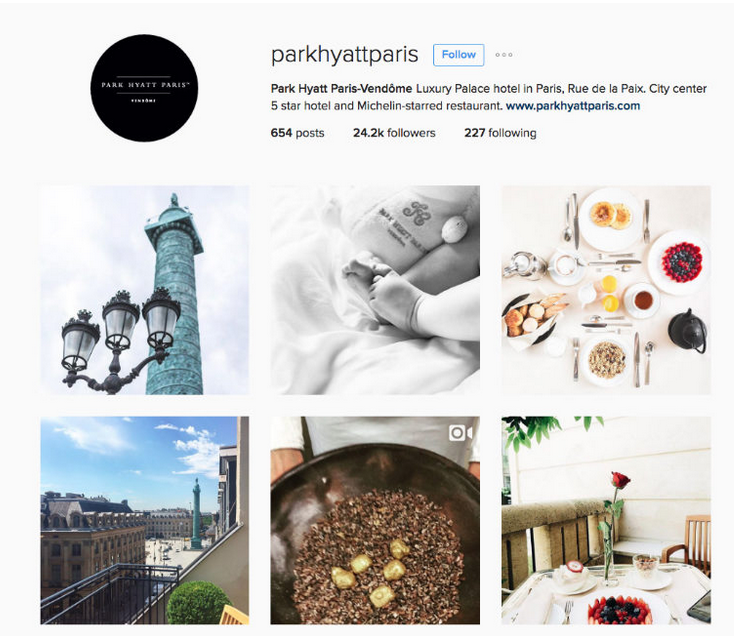
But you can use the location to your advantage. Feature nearby attractions, restaurants, and hidden gems. Position your property as the gateway to the destination, not just a place to sleep.
3. Make the most use of user-generated content (UGC)
UGC is content your guests create and share. Encourage them to tag your property, then reshare their posts with credit. People love posting holiday images, videos, Stories, and Reels, so most hotels have a lot to choose from.
UGC on Instagram, especially, builds trust because potential guests see real experiences rather than polished marketing. It also reduces your content creation workload.
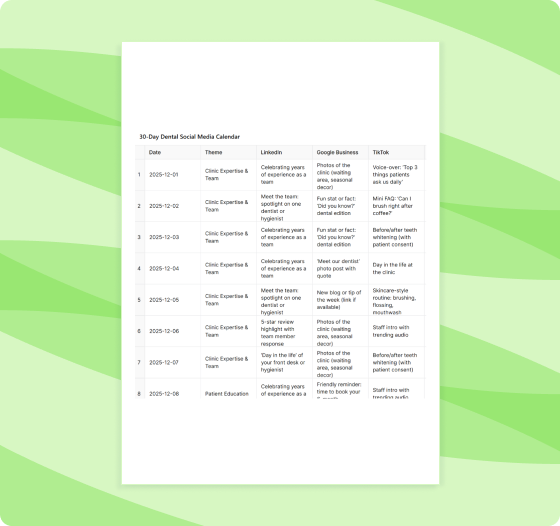
The hotel social media content calendar template.
4. Partner with travel influencers and creators
Influencer marketing involves collaborating with creators who have engaged audiences in your target market. 57% of marketers report better results with micro-influencers than macro-influencers, according to Influencer Marketing Hub. The article goes on to say:
“More than half of marketers now say the ROI is higher with micro over macro. It’s proof that sometimes smaller = smarter. Micro-influencers may not pull millions of views in one post, but what they do deliver is meaningful engagement, relevant audiences, and — most importantly — real bookings.”
5. Invest in short-form video and Reels
Reels, Stories, TikToks, and YouTube Shorts consistently outperform static images on any social platform. Room reveals, staff introductions, and "day in the life" clips all perform well.
The best format is vertical, short-form video. This is the preference for 63% of consumers who prefer it over static content.
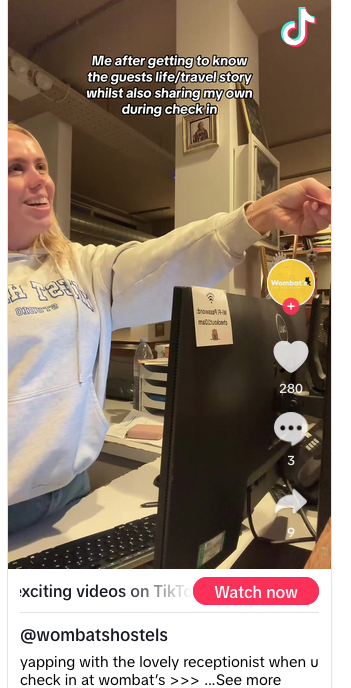
6. Post behind-the-scenes (BTS), point of view (PoV) and staff stories
Go behind the scenes by showing kitchen prep, staff spotlights, and housekeeping routines. Glimpses like this create an emotional connection and remind guests that real people are behind their experience.
People don’t want AI-generated slop. What you need is authentic content that an AI can’t replicate. It’s the only thing customers are responding to. In a sea of AI-generated sameness, stand out and create and post what makes your hotel special.
Ideas for this type of staff-filmed POV (point of view) and BTS/day-in-the-life content works well across every platform (especially Instagram and TikTok):
- A chef plating up the evening's special
- A bartender making a new cocktail
- A concierge pointing out a hidden local gem
- A hotel manager showing guests the latest calm-cation package
- A housekeeper doing a walk-through of a freshly turned room.
7. Offer "hushpitality" and calm-cation stays
Hushpitality and calm-cations are designed to appeal to guests that want to genuinely “get away from it all.” Also known as a quietcation, the idea is to lean into the JOMO (the joy of missing out).
It’s also more appealing for those looking to stay in a hotel in their home country. We can expect that to be more popular for the rest of 2026.
Hotels that adapt to the "hushpitality" trend will profit from it. Your guests will thank you, and want to come back.
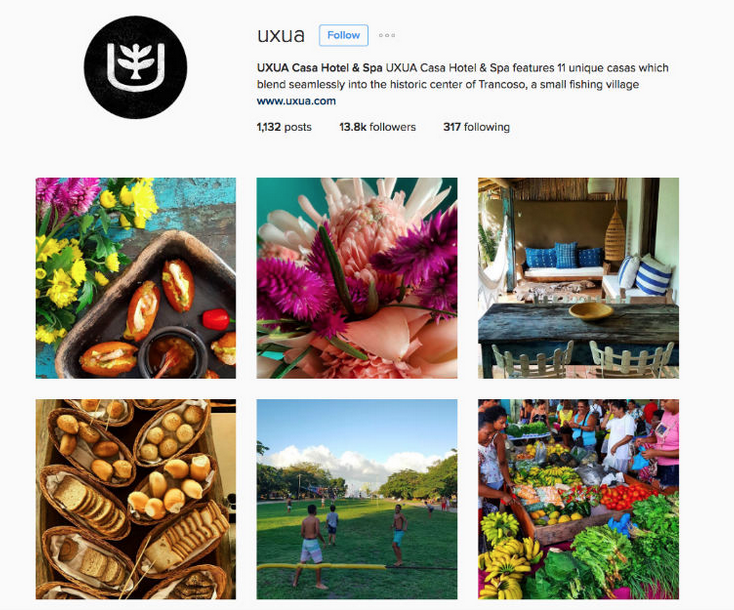
For hotel managers, you need to consider whether your hotel genuinely offers restoration, and then build content around that offer. If your property has a genuine claim to calm (a spa, a quiet countryside setting, a thoughtful approach to guest experience) let the content do the talking.
8. Use travel hashtags and geo-tags strategically
Hashtags and geo-tags increase discoverability on every social platform. Mix broad travel hashtags with niche, location-specific tags so your content reaches both general travellers and those looking at your specific destination.
9. Optimise for AI Search with Generative engine optimisation (GEO)
GEO is changing how people find hotels. AI search is reducing “click-through rates to hotel websites by 18-24% on informational queries, but increasing click-through rates on transactional queries (where the user is ready to book) by 8-12%.” (Source)
Part of this is influenced by reviews. 71% of AI-generated hotel recommendations are driven by guest reviews, according to Feefo.
Hotels that describe themselves clearly and consistently are far more likely to appear in AI Overviews and Local SEO results, which influence AI-generated answers.
On social media, AEO means writing captions that function as direct answers to real questions potential guests are asking.
Instead of a short but non-specific "A perfect weekend awaits," use a more specific caption: "Looking for the best boutique hotel for digital nomads in Seattle? Here's what we offer: fast wi-fi in every room, a quiet co-working lounge open from 7a.m., and flexible late checkout" is much stronger.
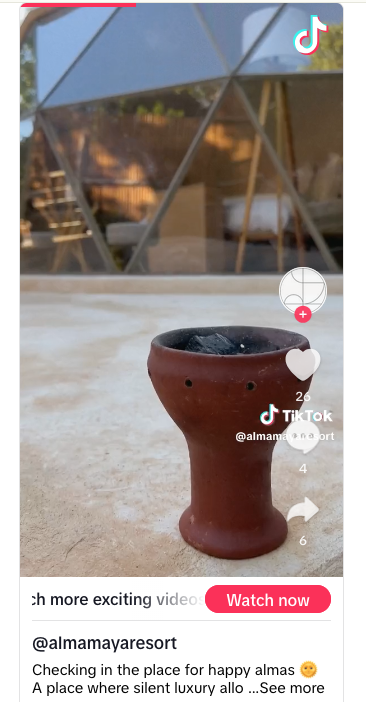
10. Produce hyper-local "experience-led" content, leaning into the Whycation trend
Whycation and experience-led “travel is driven by emotional motivations: the desire to rest, the urge to reconnect and a longing for experiences that feel meaningful.”
According to Hilton’s 2026 Trends Report, The Whycation: Travel’s New Starting Point, the question is “Why are we going?”
The practical expression of this is partnership and collab content:
- A coastal hotel that partners with a local surf school and co-creates content about the experience.
- A city-center property that teams up with a ceramics studio nearby and documents a guest's full day — check-in, create, dinner, rest.
- A rural retreat that works with a local forager to offer a guided walk and uses Instagram Collabs to share the resulting content to both audiences simultaneously.
11. Leverage TikTok as a search engine (GEO/AEO for hotels)
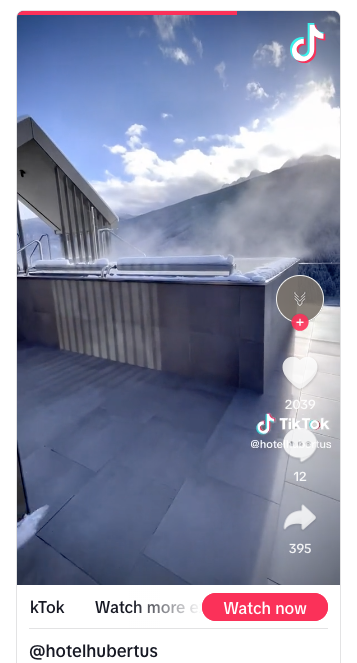
TikTok has evolved into an intent and search-driven platform where people aren’t just looking for holiday inspo but are genuinely searching for hotels, restaurants, destinations, and experiences.
According to Influencer Marketing Hub, 32% of users have booked stays discovered on TikTok. In 2026, 75% of hotel bookings are mobile-first, according to Punch Hospitality, and that’s increasingly because of TikTok.
TikTok is fast becoming the TripAdvisor for Gen Z and Millennials. A single viral TikTok showcasing a “hidden gem” hotel can spike bookings overnight.
Because of this, hotels have to reconsider their TikTok content and take it seriously. At the same time, make sure your staff is having fun creating content that’s going to actively drive conversions.
12. Add bookable CTAs and link-in-bio funnels
A CTA (call to action) directs followers to take a specific step, like booking a room. Use link-in-bio tools (like linktr.ee) and Instagram's action buttons to create a clear path from social content to your booking engine.
13. Run contests, giveaways, and guest loyalty campaigns
Giveaways increase reach and engagement. Offer a free night or dining credit as a prize, and use entry mechanics such as tagging a friend or sharing a post to organically expand your audience.
14. Collaborate with local businesses and attractions
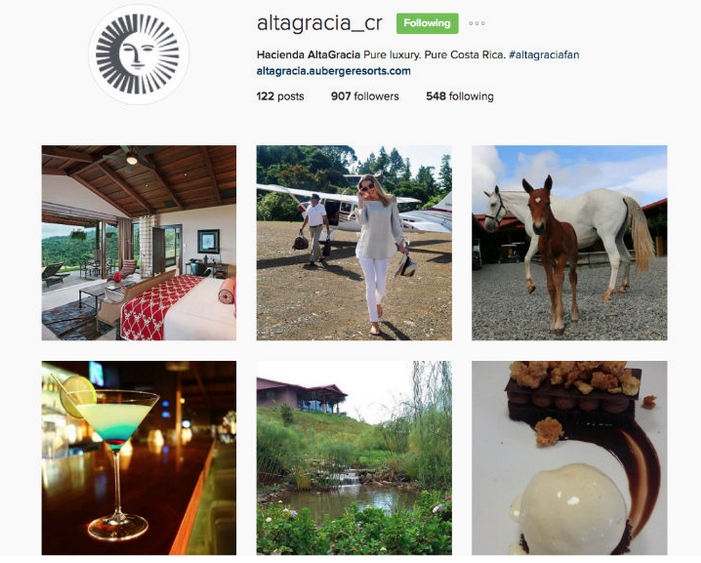
Remember, guests book because of where your hotel is, so lean into this. Cross-promotions with restaurants, tour operators, and event venues expand your reach and strengthen local ties. A joint giveaway or co-branded content series benefits both parties.
15. Combine organic content with paid social advertising
Organic reach has limits. Paid social ads let you boost top-performing posts and run retargeting campaigns to users who visited your website but didn't book. Even a modest 5-figure monthly budget can significantly amplify your best content. Just make sure you’re targeting ads where your customers are.
How to measure social media ROI for your hotel
The most effective social media ROI is measured in bookings, revenue, and OTA booking cost savings. Or advertising savings through efficiencies compared to last year. Connecting social activity to business outcomes requires tracking the right metrics.
- Direct booking conversions: Reservations directly or most likely attributed to social referrals
- Engagement rate: Likes, comments, shares, and saves relative to followers
- Reach and impressions: How many people see your content (measured across every social channel/audience size)
- Website clicks (CTR): Traffic driven from social to your booking engine
- Cost per acquisition (CPA): For paid campaigns, this is the cost to generate each booking
Automated reporting tools can consolidate performance data and generate reports without manual effort. Sendible's Report Hub automatically pulls metrics from multiple platforms into a single view, giving you a KPI-aligned and management-ready report.
How social media channels fit with hotel marketing
We covered these in brief before the 15 ideas, so let’s look at all of these in more detail.
Instagram: For travellers of every age, demographic, and budget
Instagram is the platform for visual storytelling. Reels, Stories, and carousels let you showcase rooms, facilities, on-site food and beverage (F&B), and destination highlights in a format travellers love to browse.
Put key links in your bio (or a linktr.ee to link to everything important) to drive bookings without forcing users to leave the app.
Facebook: For mass consumer engagement
Facebook remains valuable for community building, event promotion, and reaching older demographics. Its advertising platform offers powerful retargeting capabilities. So you re-engage users who visited your website but didn't complete a booking.
TikTok: For younger audiences, and the direct search-to-booking funnel
TikTok's algorithm rewards engaging content. Trends like room tours and "day in the life" videos resonate with younger travellers who are actively planning trips. We cover more about how useful TikTok is and how to use it well further down in this article.
Threads: For community building
There’s no doubt that Threads is eclipsing X (formerly Twitter). For many, many reasons. However, this means that hotels no longer need X (unless that’s where your audience is). You can now use Threads to grow your brand organically and even go viral. It’s still possible on this fast-growing platform.
YouTube: For better engagement, and GEO
YouTube works well for longer property tours, destination guides, and evergreen video content. Because YouTube videos rank in Google search results, they can support your SEO efforts over time.
LinkedIn: For B2B and event bookings
LinkedIn serves an important role for hotels targeting corporate travel, event planners, and B2B partnerships. If your property hosts conferences or business retreats, LinkedIn helps you reach key decision-makers and budget-holders when they’re in the process of planning next year’s activities.
Google Business Profile (GBP): For SEO, GEO, and Local SEO
Google Business Profile (GBP) is critical for local search, wide-scale SEO, and now GEO visibility. Regular posts, fresh photos, and prompt review responses all influence how your property appears in Google Maps and local search results. This isn’t a social network, it’s simply an integral part of SEO.
As are OTA platforms and review sites. Make sure each of these are looked after well.
|
Platform |
Best for |
Content type |
Primary audience |
|
|
Visual storytelling, destination inspiration |
Reels, Stories, carousels |
Leisure travellers, millennials, and Gen Z |
|
|
Community, events, retargeting ads |
Posts, events, and videos |
Families, older demographics |
|
TikTok |
Viral reach, trend-driven content |
Short-form video |
Gen Z, younger millennials |
|
Threads |
Viral reach, trend-driven content, community building |
Text, images, memes, GIFs, and short-form video |
Appeals to every demographic (taking over from X, formerly Twitter) |
|
YouTube |
Evergreen video, SEO/GEO |
Long-form video, tours |
Research-heavy travellers |
|
|
Corporate travel, B2B |
Articles, professional updates |
Business travellers, event planners |
|
Google Business Profile (GBP), review sites, and OTA profiles |
Local search, reviews. Even if you don’t want people booking through OTAs, you need to ensure OTA profiles are kept up-to-date and that any negative reviews are responded to quickly and professionally |
Posts, photos, review responses |
All travellers searching locally |
Now, let’s look at the 7 steps that every hotel needs to follow when marketing on social media.
7 steps for building a hotel, resort, boutique, or chain hospitality social media strategy
A clear strategy keeps your social media efforts focused and measurable. The following 7 steps walk you through creating,or refreshing,your hotel's social media approach.
Naturally, the strategy must fit your hotel type. A busy city business hotel needs different approaches than a seaside resort or hostel. We walk through the following framework:
Brand identity → audience → goals → channels → content → budget → measurement.
We’ll base this on an example: a fictional hotel, an 80-room Barcelona boutique hotel.
|
Step |
Description |
Example (80-room Barcelona boutique hotel) |
|
1. Brand Identity |
Define positioning, tone, and visual style |
“Urban explorer” archetype, playful voice |
|
2. Audience |
Identify 2-4 guest personas |
European and UK couples 30-45, remote workers 28-35 |
|
3. Goals |
Set SMART objectives |
20% Instagram booking uplift via discount codes |
|
4. Channels |
Select 2-4 priority platforms |
Instagram, TikTok, Threads, Google Business (GBP, SEO, etc.) |
|
5. Content |
Build pillars and calendar |
Rooms, local tips, rooftop scenes, and seasonal offers |
|
6. Budget |
Allocate organic and paid spend |
€2000/month (40% testing, 30% retargeting) |
|
7. Measurement |
Track with UTMs and promo codes |
15% traffic from social, 5% conversions |
Step 1: Develop your brand voice and visual identity
Brand voice is the personality and tone that comes through in your captions, replies, and Stories. Consistency matters, whether your property is playful, luxurious, or laid-back. The same applies to visuals: colours, photography style, and graphic elements all reinforce brand recognition.
Consumers expect the same high standards for big brand chains and boutiques. Although they expect more authenticity from smaller hotels.
Step 2: Define your target guest personas (audience)
Guest personas are fictional profiles representing your ideal guests. You might have:
- One persona for business travellers
- Another for couples seeking a romantic getaway
- A third for families.
Define each persona's demographics, travel motivations, and preferred platforms so your content speaks directly to them.
Step 3: Set clear goals and KPIs
KPIs (key performance indicators) are the metrics you'll track to measure success. Examples include engagement rate, reach, website clicks, UTMs, and direct booking conversions. Align your social goals with your hotel's revenue objectives so you can demonstrate real business impact.
Step 4: Choose the right channels and platforms
Spreading your team thin across every platform rarely works. Focus on two or three channels where your target guests spend time and where your content strengths shine.
- A boutique hotel with impressive interiors should prioritise Instagram and TikTok.
- A conference venue might lean into LinkedIn and Facebook.
Step 5: Build a content calendar around seasonality
A content calendar is a planning tool for scheduling posts in advance. Map your content to travel seasons, local events, and holidays so you're reaching guests when they're actively planning trips. Tools like Sendible allow teams to plan and schedule a month's content in minutes using bulk scheduling.
Step 6: Budget, Allocate organic and paid spend
If you’ve not spent any money on content creation or adverts before, then it’s going to be trial-and-error. If you’ve done this before, then you’ve got some useful data to go on. If you can, base this year’s budget on last year’s, and then extrapolate an ROI using that.
On average, budgets should be anywhere between 4% and 15% of hotel revenue. Including staff and advertising.
Step 7: Measure, track performance, and refine
Review your analytics regularly to understand what content and adverts perform best. Adjust your strategy based on data rather than assumptions. For example, if room tour Reels consistently outperform static photos, lean into that format.
How social media marketing has a positive impact on hotel revenue and bookings
|
Impact area |
Impact of social media |
|
Visibility |
Algorithmic amplification across every social channel, and increased branded searches |
|
Trust |
Review responses, authentic behind-the-scenes content (BTS), day in the lift, and point of view (PoV) |
|
Loyalty |
UGC reposts, community building, and direct relationships |
|
Revenue |
Conversion rates depend on numerous factors. But every direct booking is revenue OTAs aren’t taking, making it a win |
Manage hotel social media without burning out your team
Maintaining a consistent social presence with limited staff is a real challenge. All-in-one social media management platforms like Sendible help hotels stay active without overwhelming their teams.
Sendible lets you schedule posts across multiple platforms from one dashboard, centralise comments, DMs, and reviews in a single inbox, automate reporting to track what's working, and use AI to generate captions and suggest content ideas.
Why Sendible is the best social media tool for hotel groups
Sendible is purpose-built for the complexity of social media management for hotels. It’s ideal for hotels for a number of reasons:
Bulk scheduling for seasonal promotions:
- Seasonal packages
- National holiday offers
- Festive campaigns
- Summer season campaigns.
Sendible's bulk scheduling feature allows teams to plan and queue entire campaigns in advance. Smart queues can be set up to keep feeds active automatically, even during periods when the marketing team's attention is elsewhere.
Individual hotels can also post their own local content without it interfering with national campaigns.
Canva integration for on-brand graphics. Visual consistency across hotels, locations, and brands is one of the hardest things to maintain without the right tools.
Sendible's direct Canva integration means that designers and non-designers can create on-brand graphics within a template system. Designs can even be published directly without switching between platforms.

Automated social media reports for property owners.
For hotel groups where individual property owners or investors want visibility on social media performance, Sendible's reporting allows agencies and marketing teams to generate professional, branded reports that communicate results.
Priority inbox for guest messages and queries: Every message, comment, and mention across every property and every platform flows into a single, manageable inbox.
AIs can even assign team members and hotels specific accounts or message types (with the right integrations). Response times can be tracked, and nothing falls through the cracks. No need to worry about potential guests waiting hours for a response because of time zone differences.
Multi-property management from one dashboard.
The ability to see, manage, and report on every account across every property from a single login is the foundational feature that makes everything else possible. Instead of juggling multiple accounts and multiple logins, the entire hotel group's social presence is visible and manageable in one place.
Plans start from just $29 per month, making it accessible for independent properties as well as larger groups.
FAQs about social media for hotels
How often should a hotel post on social media?
Most hotels benefit from posting 5-10 times per week on primary platforms. Consistency matters more than volume, except on TikTok, where volume is just as important. However, on Instagram 3-5 high-quality posts per week will outperform daily content that feels rushed or repetitive.
How much should a hotel budget for social media marketing?
Budgets vary widely depending on property size, goals, location, and competitive environment.
A multi-location chain will naturally have (and need) a much larger budget than a boutique. A reasonable starting point covers content creation, a scheduling tool, and a paid advertising fund to amplify top content.
Only spend what you can afford. But don’t underspend in this area because marketing is essential for hotels. You’ll need at least one person on staff to manage this, especially if agencies or freelancers are handling the bulk of the content creation and advertising.
Which social media platform drives the most bookings for hotels?
Instagram, TikTok, and Facebook usually deliver the strongest booking results for hotels thanks to the key visual discovery elements and retargeting advertising capabilities. However, the best platform ultimately depends on your audience demographics and target guest profile.
How can boutique hotels compete with large chains on social media?
Yes, they can. Boutique hotels can win by leaning into authenticity, local storytelling, and personalised engagement.
Large, multi-location and international chains and brands often struggle to replicate that kind of genuine connection at scale. However, you can achieve that if you grant local autonomy when it comes to content creation for individual hotels.
Should a hotel hire a freelance social media manager or outsource to an agency?
Whether you hire an agency or a freelance social media manager depends on budget and the volume of work required. You’ll need an agency if the amount of work is more than one freelancer can manage. Plus, you need people with a range of skills.
Don’t assume that one person can (or should) manage everything from SEO to PPC and everything in between well. Most professional marketers aren’t skilled at everything, like design and video production. At the same time, you need at least one marketing person in-house to manage, plan, and approve everything a freelancer or agency does.
Try Sendible free with 14-day free trial.
Leverage Sendible’s extensive integrations to create, schedule, publish, and engage with your posts seamlessly.

Text copied!