

Social media for hotels is changing. Brands that are winning are beating corporate videos with unpolished, authentic, 30-second POV ones on Instagram, TikTok, and Facebook.
AI is increasingly an integral part of hotel social media marketing. But not in the way you might think. Customers use AI to find hotels. It doesn’t mean they want hotels to use AI to generate fake images and write 1000s of low-quality articles.
Authenticity is key. As is understanding these 3 and other trends for hotel marketing in 2026:
- Calm-cations, hushpitality
- Whycations
- Experience-led breaks
More about this in this article.
Have those and other trends in mind when deciding how to market your hotel or chain with the busiest season approaching: Summer.
Whether you're managing a single boutique property or coordinating content across a multi-site hotel brand in several countries, this guide covers 12 practical ways to improve your hotel's social media presence, and how to make that manageable at scale.
TL;DR: 12 ways to elevate your hotel's social media marketing strategy
- Prioritise vertical video over static images. Short-form video drives discovery; 63% of consumers prefer it over static content when researching a product or service.
- Leverage "agentic AI" for guest interactions: AI tools extend your booking and customer services team's capacity to respond to DMs and comments 24/7, reducing missed bookings. A priority inbox is also very useful for that, especially when AIs can route messages to the relevant teams and hotels automatically.
- Partner with nano and micro-influencers for high trust: Creators with 1k–10k followers can generate engagement rates from 3.5% to 17% (Instagram and TikTok), outperforming “bigger” influencer accounts on credibility and intent.
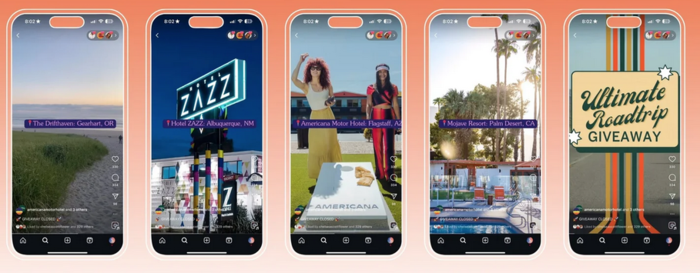
- Create authentic "un-copyable" POV content: Real footage of your team and property builds the kind of trust that no polished marketing content can replicate. Think POV and “day in the life.”
- Use TikTok as a search engine (GEO/AEO for hotels): Optimise bios, captions, and location-based hashtags for TikTok's search function to capture guests with active booking intent. TikTok isn’t just a discovery engine anymore. People are using it as the last point in the funnel.
- Create "shoppable" social moments: Booking links, Story stickers, and in-app commerce features close the gap between discovery and conversion without guests leaving Instagram, Threads, or TikTok.
- Focus on "transformation-based" storytelling: Sell the feeling of the stay, not just the facilities. Emotional content drives far stronger booking intent than a list of what a hotel has, what it’s near, or even F&B menus.
- Implement a "first-party data" capture strategy: Use social content to drive email sign-ups. Build a direct booking channel that bypasses OTA commission fees, and encourages much higher customer spend and brand loyalty.
- Showcase "hushpitality" and wellness trends: Calm, restorative content resonates with stressed travellers and stands out sharply in high-energy social feeds. If you can, learn calm-cations, make people want to take much-needed breaks in your hotel.
- Capitalise on hyper-local "passion-led" content: Partner with local experts and artisans to position your hotel as the home base for experience-driven "whycation" travellers.
- Optimise for answer engines (AEO): Write captions that directly answer guest questions so AI tools like Perplexity and Gemini surface your property in search results.
- Centralise management for multi-channel teams: A single platform for scheduling, approvals, reporting, and guest communications is essential for hotels managing multiple accounts or properties.
Let’s dive into all of these in more detail.
Why is social media for hotels changing in 2026?
The most significant shift in hotel social media is the role it plays in the guest journey.
For most of the last decade, social media was there for inspiration. A potential guest would see a beautiful image of a hotel pool on Instagram, save it. Then go to Google to actually research and book. The conversion happened elsewhere.
Social media planted the seed, but someone looking for a specific hotel could get side tracked by OTAs, travel bloggers, and from 2024, Google itself.
Very rarely would someone be able to find the hotel that originally inspired them. Even if it was available for the dates they wanted to stay.
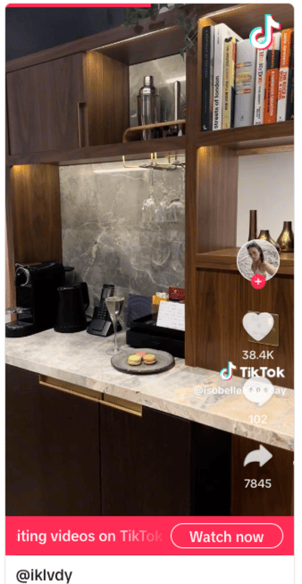
That's not the case anymore. Social media is now a full-funnel channel — discovery, consideration, and conversion all happening in the same app (usually Instagram, but increasingly TikTok, too). Sometimes within the same session. In 2025 (and this year too), 61% of travellers have booked a hotel after seeing it on Instagram. Not after clicking away to a booking site.
After seeing it on Instagram, and that usually means booking directly, which is better for hotels from a revenue-perspective.
Having an active social media presence is an operational necessity. Today's travellers conduct extensive research across Instagram, Facebook, TikTok, Google, and YouTube before making booking decisions.
At the same time, the format of social content has undergone its own transformation. Static imagery (polished, art-directed hotel photography that dominated feeds for years) is giving way to authentic, short-form videos, and shoppable experiences.
Short-form video content with embedded booking links, in-app product catalogues, and direct DM-to-booking flows are collapsing the distance between a guest seeing your property and making a booking.
This is the context in which every decision about your hotel's social media strategy now needs to be made. The question is "how do we turn social content into bookings?", and the 12 strategies below are the answer.
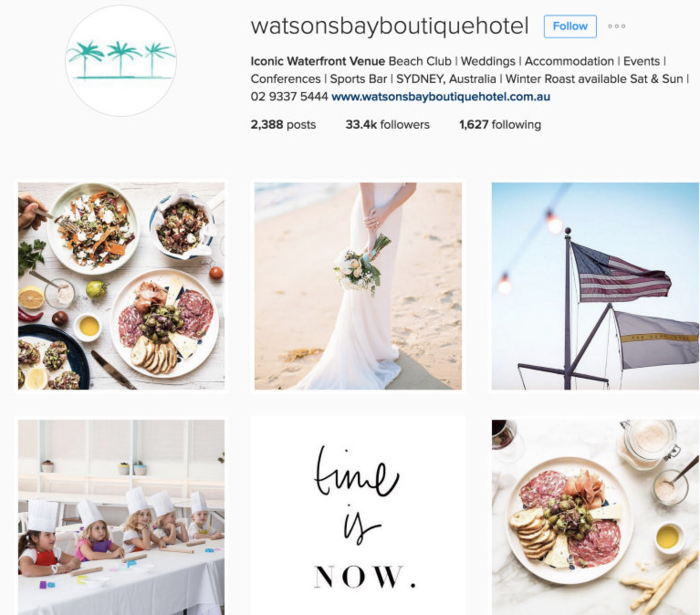
12 proven ways to boost your hotel's social media presence
1. Prioritise vertical video over static images
Vertical, short-form video is the preference for 63% of consumers who prefer it over static content when researching a product or service.
Vertical video dominates algorithmic distribution on both TikTok and Instagram. These videos reach more potential guests than static posts with equivalent engagement. Hotels that have made the shift are seeing their content surface to audiences far beyond their existing follower base, which is where the growth is.
Start treating vertical video as your primary content format. Even modest production — a member of staff with a smartphone and a steady hand — can produce content that outperforms expensively produced static imagery if it captures something genuine.
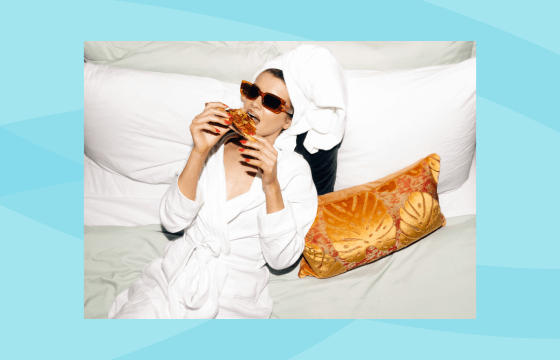
How to Promote a Hotel Chain: Strategies for Brand Consistency and Scale
2. Leverage Agentic AI for guest interactions
Social media has become the preferred customer service channel for many guests and potential guests. Unfortunately, the volume of messages, comments, and enquiries that a hotel's social accounts receive can be overwhelming.
For hotel teams, the challenge is keeping up. A potential guest enquiring about availability at 11pm on a Sunday doesn't want to wait until Monday morning for a reply. They’ll have already booked somewhere else. A comment asking whether the hotel is dog-friendly left on a TikTok video shouldn't go unanswered for three days.
Response time has become a genuine factor in booking decisions. Gaps in coverage cost hotels direct business.
Agentic AI can solve those problems, within defined parameters. Importantly, agentic AI is designed to extend the ability of human-centric service. Answering questions when no one is able to do that work.
Your team can focus their attention on interactions that genuinely require human judgement, while AI ensures that no message goes unanswered and no potential booking falls through the cracks because of a slow response.
3. Partner with micro and nano-influencers for high trust
In the hotels sector, the influencer marketing landscape has matured considerably. What you need are smaller-scale influencers with a much more engaged audience.
57% of marketers report better results with micro-influencers than macro-influencers, according to Influencer Marketing Hub. The article goes on to say:
“More than half of marketers now say the ROI is higher with micro over macro. This stat alone should flip traditional thinking on its head. It’s proof that sometimes smaller = smarter. Micro-influencers may not pull millions of views in one post, but what they do deliver is meaningful engagement, relevant audiences, and — most importantly — real bookings.”
For hotels, this means that a weekend stay gifted to a food and travel creator with 6,000 loyal local followers can generate more meaningful interest, and booking intent, than a paid post from an influencer with an audience of 200K but a fraction of the connection.
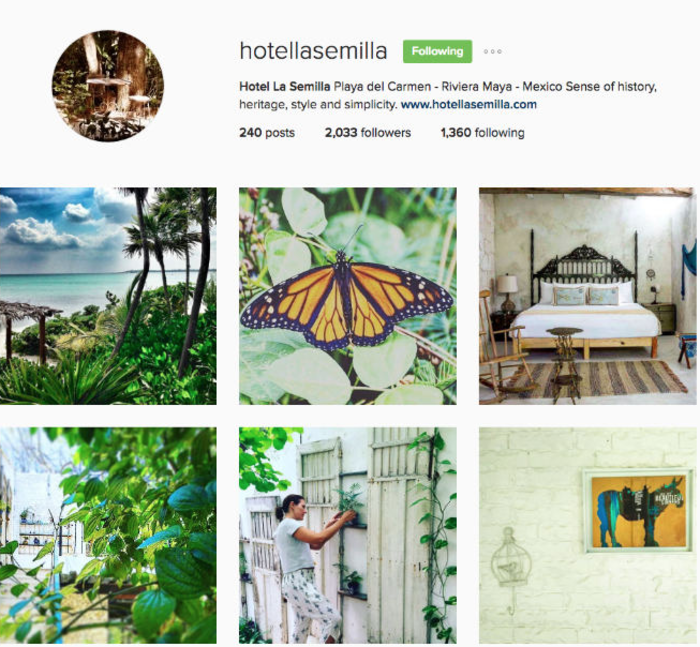
4. Create un-copyable BTS/POV content
AI can’t replicate how your hotel makes people feel. Nor can it replicate your team.
People don’t want AI-generated slop. It won’t entice them to book. Neither will 100s of AI-generated articles in an attempt to trick Google’s algorithms and other AIs to rank and cite your hotel as the destination in your local area.
No, what you need is authentic content that an AI can’t replicate. It’s the only thing customers are responding to. In a sea of AI-generated sameness, stand out, be old school; create and post what makes your hotel special.
Social Media Content Calendars for Property Managers: Plan Better, Post Smarter
Ideas for this type of staff-filmed POV (point of view) and BTS/day-in-the-life content works well across every platform (especially Instagram and TikTok):
- A chef plating up the evening's special
- A bartender making a new cocktail
- A concierge pointing out a hidden local gem
- A hotel manager showing guests the latest calm-cation package
- A housekeeper doing a walk-through of a freshly turned room.
It feels real. It is real. Authenticity translates directly into trust, and trust turns into new hotel bookings.
5. Use TikTok as a search engine (GEO/AEO for hotels)
In 2026, 75% of hotel bookings are mobile-first, according to Punch Hospitality.
TikTok is at the heart of that shift, and that’s no longer limited to Gen Z.
TikTok has evolved into an intent and search-driven platform where people aren’t just looking for holiday inspo, but are genuinely searching for hotels, restaurants, destinations, and experiences.
According to Influencer Marketing Hub, 32% of users have booked stays discovered on TikTok.
TikTok is fast becoming the TripAdvisor for Gen Z and Millennials. A single viral TikTok showcasing a “hidden gem” hotel can spike bookings overnight.
Because of this, hotels have to reconsider their TikTok content, and take it seriously. At the same time, make sure your staff are having fun creating content that’s going to actively drive conversions.
Every video counts. At the same time, think of every TikTok caption as a micro-FAQ. The more directly and specifically it answers a real question a potential guest might ask, the harder it works for your hotel's discoverability (feeding into GEO).
6. Create shoppable social moments
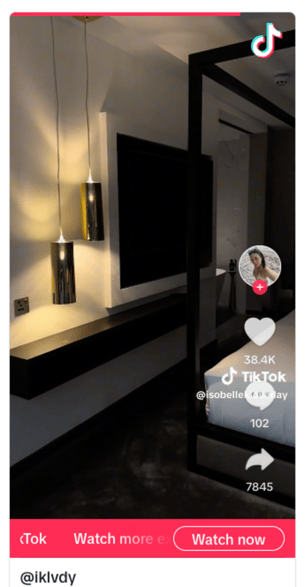
The quickest route between a potential guest seeing your hotel and making a booking is one that never requires them to leave the app they're already in. Shoppable social content — content that integrates booking links, stickers, and direct calls to action into the content experience itself — is making that possible.
As mentioned above, 32% of users now book directly via TikTok. That's a substantial portion of bookings that are being made without the guest ever visiting a hotel website or an OTA. Hotels that make it frictionless to book from within the social experience will capture bookings that might otherwise be lost in the gap between inspiration and action.
Social media streamlined for multi-location hospitality brands.
The content that converts best in this context tends to be specific and immediate — a video showcasing a particular room type with a direct "book now" prompt performs better than a generic property highlight. Give the viewer something to want, then make it as easy as possible to act on that want.
7. Focus on experience/emotion-based storytelling
These days, guests are wanting to book the version of themselves that wakes up slowly, drinks good coffee on a terrace with a view, and feels, for a moment, like they're living differently. It’s a feeling, an emotion, something to aim for.
The most effective hotel social media content understands this and sells the transformation, not the transaction.
Experience or emotion-based storytelling means evoking what it feels like to experience your rooms, restaurant, bar, spa, or breakfast.
"The first sip of coffee on our terrace" is a more powerful piece of social content than "Breakfast served 7–10am daily." One sells a feature; the other sells a feeling that your potential guest can already imagine themselves inhabiting.
In video content, transformation-based storytelling means considering the arc of the experience rather than simply showcasing the space. Use the following for inspiration:
- Show seamless guest arrivals (authentically, not staged)
- Show the lightness a guest feels at arriving
- Show the unhurried morning
- Show the moment a guest looks out of the window and feels happy that they're somewhere special.
8. Implement a first-party data capture strategy
Social media reach is ultimately rented. Algorithms change, platforms shift, and the audience you've built on TikTok or Instagram is owned by the platform rather than any brand.
First-party data (e.g., email addresses, direct contact details, and guest preferences captured with permission, etc.) is the asset that belongs to your hotel and compounds in value over time.
Social media is one of the most effective tools available for building that first-party data pool. Content that offers something genuinely valuable in exchange for an email sign-up — an exclusive member rate, early access to seasonal packages, a guide to the local area — can turn a social media follower into a direct marketing contact.
Over time, a well-maintained email list of guests and prospective guests who have actively opted in represents a direct booking channel that bypasses OTA commission fees entirely. Giving you a meaningful commercial advantage for any independent, chain, or boutique property.
9. Showcase "hushpitality" and calm-cations
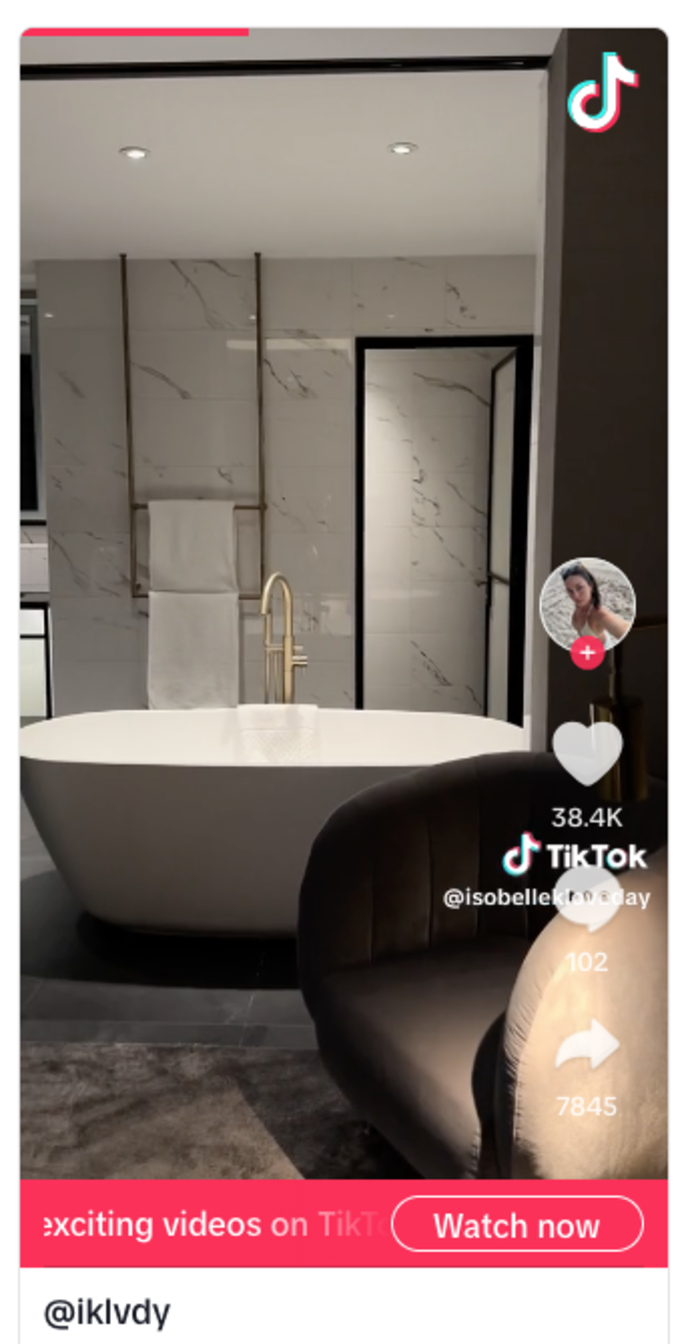
Hushpitality and calm-cations are designed to appeal to guests that want to genuinely “get away from it all”, even if that’s in the middle of a city.
Also known as a quietcation, the idea is to lean into the JOMO (the joy of missing out).
People are burnt out.Tired. Fed up of screen time. A calm-cation helps people genuinely detox from digital, enjoy a quieter, calmer time, and de-stress from their everyday lives.
The "hushpitality" trend — a move towards calm, quiet, restorative hospitality experiences — has found its social media expression in content that mirrors the peace it's selling. Silent videos. Ambient footage. The sound of rain on a window, a fire in a grate, a breakfast plate arriving without fanfare.
All of this is quiet, peaceful content that makes the viewer exhale before they've consciously registered why.
For hotel managers, you need to consider whether your hotel genuinely offers restoration and to build content around that offer. If your property has a genuine claim to calm — a spa, a quiet countryside setting, a thoughtful approach to guest experience — let the content reflect that without overselling it.
10. Whycation: Capitalise on hyper-local "experience-led" content
According to Hilton’s newly released 2026 Trends Report, The Whycation: Travel’s New Starting Point, the question is “Why are we going?”
Whycation and experience-led “travel is driven by emotional motivations: the desire to rest, the urge to reconnect and a longing for experiences that feel meaningful.”
The practical expression of this is partnership and collab content:
- A coastal hotel that partners with a local surf school and co-creates content about the experience.
- A city-centre property that teams up with a ceramics studio nearby and documents a guest's full day — check-in, create, dinner, rest.
- A rural retreat that works with a local forager to offer a guided walk and uses Instagram Collabs to share the resulting content to both audiences simultaneously.
The starting point for any hotel social media manager pursuing this approach is a simple audit:
- Who are the most interesting, most authentic local voices in your area (people doing things they’re passionate about and good at)
- What would a genuine partnership with them actually look like for your guests?
- And can you make it happen?
11. Optimise for answer engines (AEO); Generative engine optimisation (GEO)
GEO is changing how people find hotels. Reducing “click-through rates to hotel websites by 18-24% on informational queries, but increasing click-through rates on transactional queries (where the user is ready to book) by 8-12%.” (Source)
Part of this is influenced by reviews. 71% of AI-generated hotel recommendations are driven by guest reviews, according to Feefo.
Hotels that describe themselves clearly and consistently are far more likely to appear in AI Overviews and Local SEO results, which influence AI-generated answers.
On social media, AEO means writing captions that function as direct answers to real questions potential guests are asking.
Instead of "A perfect weekend awaits," a caption that reads "Looking for the best boutique hotel for digital nomads in Seattle? Here's what we offer: fast wi-fi in every room, a quiet co-working lounge open from 7am, and flexible late checkout" is much stronger.
12. Centralise management for multi-channel teams
Implementing the 11 strategies above involves producing consistent content across multiple platforms. Social media for hotel chains involves managing a wide range of channels and accounts:
- 1 for the brand across every channel
- 1 for each location, also across every channel
- Some hotels might also be managing an in-house F&B brand for every location too, or a spa/wellness centre
That’s a lot of social channels and platforms. For brand consistency, you need to manage those centrally. But at the same time, each location and sub-brand (F&B or spas, etc.) needs to have the ability to make on-site content, offers, and promotions.
Centralised social media management tools are the practical solution to this challenge. For hotel groups managing multiple properties, they're an operational necessity.
The right platform allows a small team to schedule content across every channel and every property from a single dashboard, maintain consistent brand standards while allowing property-level customisation, and generate the kind of reporting that helps justify investment and refine strategy.
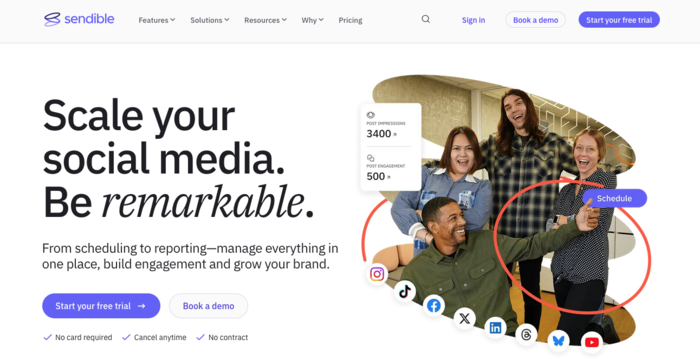
Social media tool Sendible is popular with hotel chains, brands, and operating teams. It’s also used by agencies to manage hotel social media marketing on behalf of busy in-house marketing teams.
How can hospitality teams manage social media across multiple channels?
For a single-property hotel with a small marketing team, managing social media is demanding.
Even for a hotel group with multiple properties, each with their own Instagram, TikTok, and potentially a separate spa or F&B, it can quickly become unmanageable.
The pain points are familiar to anyone who's been in this position. Content needs to be planned, produced, approved, and scheduled separately for each account.
Brand consistency across properties is difficult to maintain when each location is working from its own files and templates. Guest messages arrive across multiple inboxes on multiple platforms. Without a centralised system, things get missed, and it can get even more stressful. Reporting requires pulling data from several sources and stitching it together manually.
Alongside this, individual hotel managers need to have the freedom to publish local and timely content when it’s needed and useful. It’s crucial to help them hit revenue targets and shift inventory.
At the same time, national and international brands still need to control the overall messaging, visually, and the words put into every social posts.
You need a social media tool that can do both. Deliver centralised planning, content, and approvals, whilst also giving hotel managers and marketing staff the ability to publish on-site (e.g., those popular POV short videos) and be reactive to things happening in the local area.
With Sendible, you can do both, and so much more.
With Sendible, the efficiency gains compound over time. A hotel group that invests in centralised social media management is building a scalable infrastructure that can grow with the business.
Why Sendible is the best social media tool for hotel groups
Sendible is purpose-built for the complexity of social media management for hotels. Especially social media teams managing multiple properties or working with an agency or a freelance group.
It’s ideal for hotels for a number of reasons:
Bulk scheduling for seasonal promotions. Hotel social media has a natural rhythm:
- Seasonal packages
- National holiday offers
- Festive campaigns
- Summer season campaigns.
Sendible's bulk scheduling feature allows teams to plan and queue entire campaigns in advance. Making sure that promotional content goes out at the right time without requiring manual intervention during busy operational periods.
Smart queues can be set up to keep feeds active automatically, even during periods when the marketing team's attention is elsewhere. At the same time, individual hotels can also post their own local content without it interfering with national campaigns.
Canva integration for on-brand graphics. Visual consistency across hotels, locations, and brands is one of the hardest things to maintain without the right tools.
Sendible's direct Canva integration means that designers and non-designers can create on-brand graphics within a template system. Designs can even be published directly without switching between platforms.
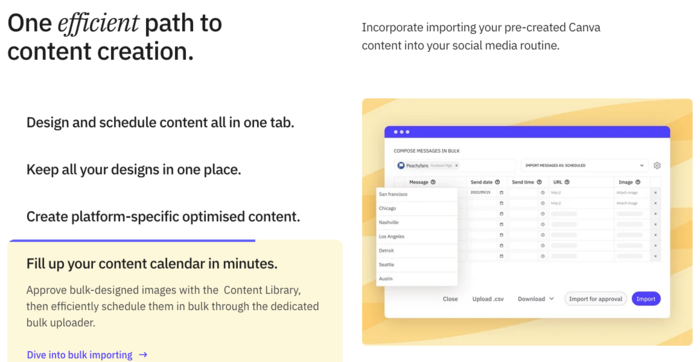
For hotel groups with strict brand guidelines, this single feature eliminates a significant source of inconsistency and friction.
Automated social media reports for property owners.
For hotel groups where individual property owners or investors want visibility on social media performance, Sendible's reporting allows marketing teams to generate professional, branded reports that communicate results.
This is useful for agencies managing hotel social media on behalf of clients. It keeps communication clean, professional, and focused on the metrics that matter.
Priority inbox for guest messages and queries.
Every message, comment, and mention across every property and every platform flows into a single, manageable inbox.
AIs can even assign team members and hotels specific accounts or message types (with the right integrations). Response times can be tracked, and nothing falls through the cracks, no matter the time of day or the volume of incoming messages.
Multi-property management from one dashboard.
The ability to see, manage, and report on every account across every property from a single login is the foundational feature that makes everything else possible. Instead of juggling multiple accounts and multiple logins, the entire hotel group's social presence is visible and manageable in one place.
For hotel operators, CMOs, and marketing managers who are serious about social media as a revenue channel, Sendible provides the infrastructure to execute at scale without sacrificing quality or consistency.
Plans start from just $29 per month, making it accessible for independent properties as well as larger groups.
FAQs: Common questions about social media for hotels
How often should a hotel post on social media in 2026?
Consistency matters more than volume. But you still need to have the volume, providing the quality can be maintained at scale. All of this is easier with a dedicated social media team, or an in-house marketing team, supported by an agency or freelancer(s).
As a general rule, hotels should aim to post on:
- Instagram 3-5 times per week, combining feed posts, Reels, and Stories.
- On TikTok, a higher volume (8-12) is generally rewarded by the algorithm
- For other platforms, a steady 4-8 posts are useful. Because Instagram and TikTok are more visual, they matter more and should take more time to create.
Quality should never be sacrificed for the sake of hitting a posting target. A hotel posting twice a week with genuinely engaging, well-crafted content will outperform one posting daily with filler. Aim to build a content calendar that's ambitious but sustainable. One the team can maintain consistently over time without burning out or resorting to content that adds no value. Or re-posting too often on Instagram because there’s a penalty if you do that more than 10 times in a month.
Centralised scheduling tools make it significantly easier to hit these targets, because content can be planned, created, and queued in batches. At the same time, hotels having control over what they can post means they can be reactive.
A morning spent planning and scheduling two weeks of content is far more efficient than scrambling to find something to post each morning.
Which social platform is best for hotel bookings?
In 2026, that depends on your property type, number of hotels, location(s), and your target guests (ICPs). But if you're looking for a single platform to prioritise for direct booking intent, TikTok has become the most commercially useful for most hotels.
Its combination of high organic reach, strong discovery mechanics, and increasingly mature in-app commerce features means that the distance between a guest discovering your hotel and completing a booking is shorter on TikTok than anywhere else.
Instagram remains essential, particularly for properties where visual identity and aspirational imagery are central to the brand. Its audience skews slightly older than TikTok's and tends to have higher disposable income. Useful for luxury and upper-midscale properties. Instagram Stories and Reels both drive meaningful booking traffic when used with clear CTAs, offers, and regularly updated booking links.
For hotels targeting business travellers or building B2B relationships (corporate accounts, event bookings, and group travel) LinkedIn is worth including in the strategy. However, you need to remember that it functions differently from B2C platforms and requires a distinct content approach.
As always, every platform (and we’re still including Facebook in that, but swapping X for Threads) is useful to have in the social media strategy. It’s only TikTok that is taking on greater importance this year.
Try Sendible free with 14-day free trial.
Leverage Sendible’s extensive integrations to create, schedule, publish, and engage with your posts seamlessly.

Text copied!