
In 2026, an important social media battleground is Bluesky vs Threads.
Both are worthy successors to Twitter (now X) as it was (pre-Musk). Both appeal to people and, therefore, brands that want a nicer platform. A place that’s more brand-friendly and less negative.
We've seen firsthand which platform offers greater immediate potential. Sendible achieved a staggering 30,000% increase in Threads views in our first three months.
If you’re deciding where to build your brand’s community, this 2026 guide is an essential comparison of Threads and Bluesky.
TL;DR: Threads vs Bluesky comparison table
|
Feature |
Bluesky |
Threads |
|
Ownership |
Bluesky Social PBC (open-source) |
Meta |
|
Launched |
2023 (Invite only, initially, by the former Twitter CEO Jack Dorsey). |
July 5, 2023 |
|
Active Users |
41 million |
400+ million |
|
Text Character Limit |
300 |
500 |
|
Content Formats |
Text, photos, GIFs, videos, links |
Text, images (up to 10), videos, links, vanishing posts |
|
Feed Type |
Chronological, user-curated |
Algorithmic, AI-curated |
|
Engagement |
Very high (3× more than X/Twitter) |
Moderate (6.25% median rate) |
|
Advertising Tools |
None |
Yes (Meta-based) |
|
Analytics |
Limited |
Yes (Meta-based) |
|
Instagram Integration |
No |
Yes, and Facebook |
|
Best For |
Community building, niche audiences |
Broad reach, brand awareness, and with better engagement than other social platforms |
|
Audience Age |
Primarily 18–34, liberal, tech-centric |
Primarily 25–34, liberal (although growing every day into other age groups) |
|
Gender Split |
~60–70% male |
~57–58% male |
Bluesky vs Threads: Which is better and what’s the difference?
Before we can decide which social media platform is better, let's learn about each one.
Bluesky is a decentralised, open-source social media platform owned by Bluesky Social PBC. Interestingly, this X competitor was first founded within X when it was still Twitter.
On this platform, users can post photos, videos, links, and text with a limit of 300 characters. It's a place to share opinions and curate your feed with customisations.
So, how many people are using Bluesky? Is it worth it for businesses?
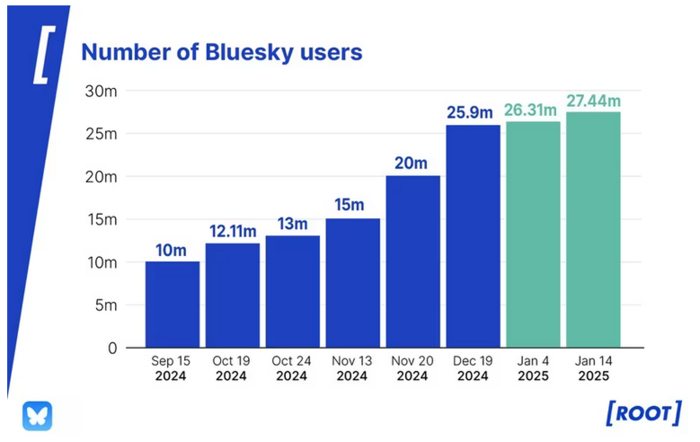
As of January 2026, this microblogging app has over 41 million users.
How does that compare to Threads?
Threads is operated by Meta, the social media giant that runs Facebook, Instagram, and WhatsApp. It benefits from a steady influx of new users from Facebook and Instagram.
Threads is still benefiting from posts being embedded in everyone’s Facebook feed, encouraging users to set up a Threads account (if they don’t already have one).
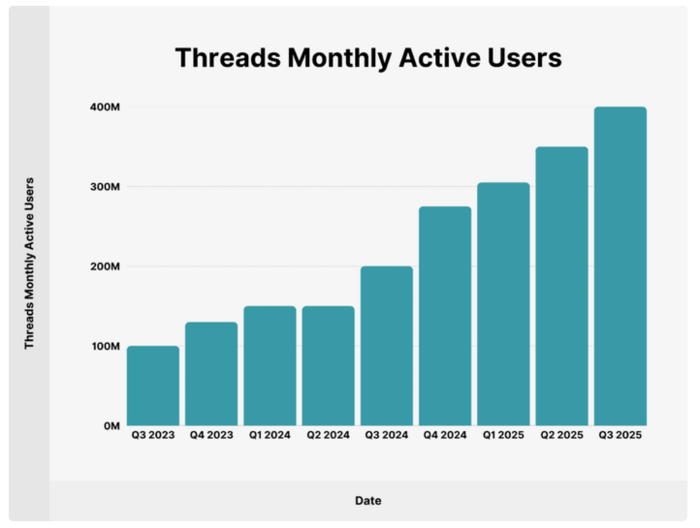
It serves over 100 countries in 31 languages and was launched on July 5, 2023. At the end of 2025, Threads had over 400 million active users (with at least 120m active daily, and 275m active monthly). This is a pretty big difference compared to Bluesky's 36 million users.
What is the difference in audience and user behaviour on Threads and Bluesky?
The audiences for both Bluesky and Threads are very different.
Threads demographics
Based on data gathered towards the end of 2025, this is what we know about Threads user-base right now:
Age distribution:
- 25-34: 28.75% (Largest group)
- 18-24: 20.36% (Second largest)
- 35-44: 19.15%
- Over 60% of users are 18-34, indicating a very young demographic.
Gender: Approx. 57–58% male / 42–43% female.
In comparison, here’s the latest data from Bluesky:
Bluesky demographics
Age distribution:
- The largest segment is 18–34
- Roughly 33% aged 18–24 and 27% aged 25–34
- Only about 5–6% of users are over 65.
Gender: Studies show a male-skewed user base (approx. 60–70% male).
If there is one thing that sticks with you during this comparison, it's that Bluesky users have much higher engagement rates than other platforms. They are 3x more likely to engage than X/Twitter users.
What about Threads? The demographics behind Threads users are similar to an extent. Most people who use Threads do so because they are integrated with Instagram.
On Threads, the largest percentage of users are young, usually aged 25-34.
What about engagement?
How do Bluesky and Threads compare?
On Threads, the engagement is nowhere near as high as it is for Bluesky. The median engagement rate of a post on Threads is 6.25%.
Best-performing content formats and posting experience
Posting on Bluesky and Threads looks different. Even though they both started out as text-based social media apps, they’ve diverged in nature and the user experience, which is to be expected when one is open-source and the other is Meta-owned.
Bluesky
Posting on Bluesky is straightforward. On this app, you can post short updates, text (up to 300 characters), photos, GIFs, and videos.
Working with multiple social media apps can be overwhelming. You don’t have to feel overwhelmed when using a Bluesky scheduling tool like Sendible.
Bluesky is a highly engaging, community-driven app. The overall app and audience are community-focused.
However, it can be confusing to understand the different ways to curate your feeds. Bluesky lets you customise your feed, giving you control of what you see.
For business owners, this can be tough since the reach is smaller. There is no guarantee that someone will want to interact with your content.
Bluesky is growing rapidly. It’s also a more engaging platform. According to recent data,“people click on shared links more often on Bluesky and conversations go deeper”, and this is good for businesses building a community on this platform.
An advantage for businesses using Bluesky is the ability to experiment. The app is new and very customisable, so it can look different for everyone. It's an opportunity to learn and stand out early.
Although Bluesky is a solid social media platform for engagement, there are disadvantages. For example, app growth is organic, so there aren't any advertising tools. This can really stunt a business's growth.
Threads
Threads lets you post a lot of different content formats compared to Bluesky:
- 500 characters per post
- Up to 10 images
- Videos
- Links
- Even vanishing posts and hidden words/characters
- And emojis, of course.
Your feed on Threads is determined by an algorithm you don't have control over. This is a stark difference compared to how Bluesky does things.
Threads has its own advantages and disadvantages. One of its advantages is the reach. Who wouldn't want the potential to reach 400 million people?
It's also more engaging than its top competitor, X. Still, Bluesky has it beat there.
Instagram remains one of the most used apps in the world, with a large reach. It has over 3 billion active users worldwide.
Sendible's Threads report and research show that only 1% of its users added a Threads account to the social media management platform, and only 0.7% of them posted to it in the last 30 days. That means this can be your golden ticket to brand awareness!
Brand presence: Which platform gives you more visibility?
Any visibility is great, even if it's from a small number of people. Business owners should consider using both Threads and Bluesky, but for different reasons.
Bluesky is perfect for building a niche and a tight-knit community, as engagement rules here. Because the app is still growing, you can also become one of its first faces.
It's a lot harder to grow on social media when an app already has 400+ million users than when it has just 41 million.
Threads biggest selling point for businesses' visibility is its relationship with Instagram. It has a larger reach than Bluesky and discoverability through Instagram, an app used by over 3 billion people.
A great way to boost your visibility and engagement is to use social media scheduling platforms. Although Threads is a newer social media app, plenty of platforms allow integration, making it easy to batch content, like Sendible.
Analytics and insights: What can you actually track?
How can you tell when a post or strategy is working without tracking data and analytics? Bluesky and Threads track some data, although both are very limited.
For instance, on Bluesky, there isn't much information in posts. Instead, it's easier to use platforms that let you enter your account information.
A popular one for Bluesky is Bluesky Analytics, a free online tool that tracks followers, posts, and growth.
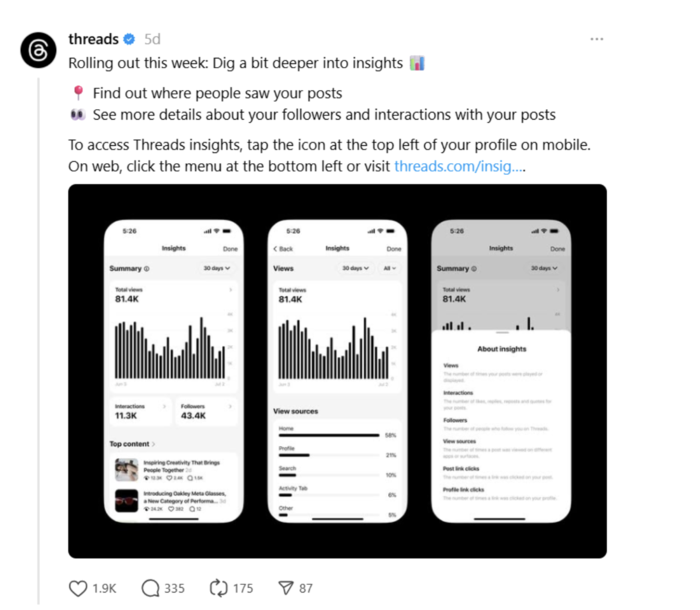
Threads offers more information than Bluesky, even if the analytics isn’t quite as advanced as Instagram. According to Instagram's help center, the insights available to users include total views of your content, interactions, and followers.
However, Meta is working on that, so we can expect more comprehensive analytics coming to the platform soon.

Algorithmic reach vs. chronological feeds: What wins in 2026?
Bluesky has opted for a user-built chronological feed. Like how Twitter worked, long before it picked the algorithmic route.
That’s why Bluesky sees 1.5-2x increases in engagement during big moments that bring society together, like the World Series, election night 2025, and many others.
Threads, on the other hand, is algorithmic, and increasingly, AI-curated.
Based on what users simply accept as the norm, algorithms and AIs have long-since won the argument.
That’s why people spend time curating their algorithm to the extent they can. Following and unfollowing brands and things they’re interested in. Muting people and words they don’t want to see.
For brands and businesses, it means being consistently proactive with the content you post to win a place in your customers' algorithmically curated feed.
Here is how you do that on Threads as a business.
Is Bluesky better than Threads for B2B brands?
With all the information we've gathered, let's dive into the real reason you're here: which platform is better for your B2B brand? (We are asking that because the majority of Sendible customers are B2B brands; although, we do have some B2C brands, and agencies working for them).
The short answer is both! The long answer depends on what you are looking for. Threads and Bluesky have advantages that any business can use to boost engagement and attract customers.
Both of them are useful for different reasons. Bluesky is the best for community building because of how engaging the community is and the feeds' customisability.
With Bluesky, users actively seek out your content, which can increase the likelihood of gaining followers and supporters.
Threads gives you a much larger reach, is growing, is less niche than Bluesky, and is the true (nicer) success to Twitter (now X).
As ever, it comes down to your customers. Are they on Threads, Bluesky, or both?
Invest in where your audience is, or where they’re going. If in doubt: Ask them.
Use a platform where you get larger engagement, like Instagram, and run a poll. If your customers/audience say Threads, stick with that. But if they’re more Bluesky-centric, then it’s a good reason to use that.
 Source: @threads
Threads is a stronger option for brands that need to reach a larger audience. It’s a much more effective replacement for Twitter.
More people use Instagram and Threads, which means more potential engagement, clicks, and revenue from both.
It's also popular across every sector, including SaaS, multi-location brands, and lifestyle. Brands that use threads include Beyond Meat, Grammarly, and Wendy's.
And yes, Sendible uses it, too!
Threads vs Bluesky FAQ
Can brands use Bluesky and Threads at the same time?
Brands can use Bluesky and Threads without any problems. There is no law or rule that limits the use of both apps. Using both apps can increase your reach. And you can use Sendible’s Smart Compose Box to easily tailor copy to match both platforms’ vibes.
Which platform is better for engagement?
Bluesky is better for engagement. The platform has a smaller niche and a supportive audience, both known for their engagement scores.
Is Bluesky really decentralised—and does that matter for marketing?
Bluesky is really decentralised. This means that the app is not controlled by one single organisation. It also gives the user a lot of control and offers transparency at every step.
So, what does this mean for marketers? It means that Bluesky offers a challenge. While you can't rely on advertising as a marketer when using Bluesky, you can create meaningful and authentic content and respond to replies in a similar way.
Try Sendible free with 14-day free trial.
Leverage Sendible’s extensive integrations to create, schedule, publish, and engage with your posts seamlessly.

Text copied!