

Employee advocacy at scale means hundreds or thousands of employees, agents, branches and locations sharing approved, personalised brand content from their own social profiles. It isn’t new. What’s changed is that AI assistants now draw on that public social activity when they describe your people, locations and brand, which makes a distributed social presence more valuable than ever.
We’re speaking to more enterprise and multi-location organisations about this than ever before, across financial services, real estate, property management and healthcare. They want their employees, agents, branches and locations more active on social, without losing central control. Shape Software, which has over 100,000 users, uses Sendible as its social layer, giving distributed teams of loan officers and agents a way to manage social through one central platform.
Why employee advocacy matters for AI search: social is part of how AI finds you
AI systems don’t treat every social platform the same way. LinkedIn is increasingly a source for company and professional information (it’s also why the LinkedIn algorithm now rewards consistent, credible posters). Instagram and Facebook surface current brand and location information. YouTube is widely used for research and buying questions, while platforms like Reddit supply the opinions behind comparison-style answers.
Different platforms. Different signals. One increasingly connected discovery ecosystem.
For large organisations, social is no longer only something followers see. It’s part of the public information AI systems use to understand your people, locations and brand. Two patterns stand out. AI tools disproportionately cite people who post consistently. And on ChatGPT, profile and entity pages account for a larger share of a platform’s citations than individual posts do, so an active, up-to-date profile for every branch or location matters as much as any single post.
For an enterprise, that consistency can come from hundreds of active people and locations, not one corporate account.
People add reach too. The Employee Advocacy Benchmark 2026 reports that personal posts can reach up to 800% more people than the same content on a company page.
Employee advocacy examples across enterprise and multi-location organisations
A central team provides the campaign, guardrails and approved messaging, while employees, agents, branches or locations make it locally relevant.
How to run employee advocacy at scale
For a team of ten, employee advocacy is easy. Across hundreds or thousands of people and locations, four problems appear fast: cost, security, personalisation and participation. Here's how organisations solve each one with Sendible.
Cost: Workspaces and unlimited users
Per-seat pricing gets expensive fast when hundreds or thousands of people need access. Workspaces give each person, team, location or brand its own profiles and calendar, all managed from one account, and plans include unlimited users.
Security: Client Connect
Employees connect their own social accounts securely, without sharing usernames or passwords, and stay in control of their profiles.
Participation: templates, sharing and approvals
Approved templates mean nobody starts from a blank page. The Share button lets employees share from your own website or CMS without logging into Sendible, and approvals keep marketing and compliance in control.
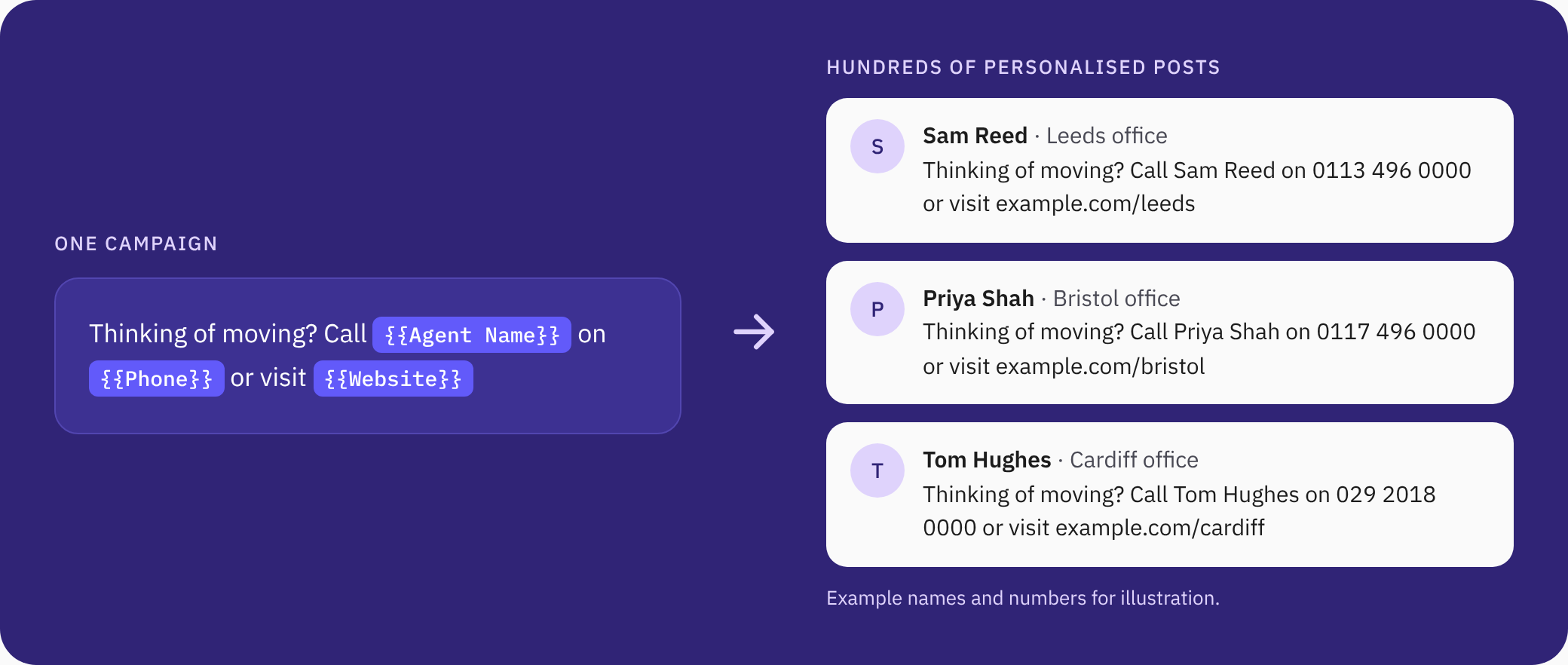
Personalisation: Dynamic Fields
One campaign automatically fills in each person's or location's name, phone, website and other details, as shown below.
How to measure employee advocacy ROI
Large organisations will want proof that this is working. In Sendible, posts can be grouped under a Campaign, so you can measure an advocacy initiative separately from the rest of your social activity.
Engagement reports give you an overview of how the wider organisation is performing, while custom reports drill down into individual employees, branches, locations or teams. The metrics worth tracking:
-
Output: how many people and locations are posting, and how often
-
Reach and interactions: who saw it and who engaged
-
Audience growth: follower growth by person, branch or location
-
Top-performing content: which templates to reuse
-
Traffic, conversions and ROI: add UTM tracking and Google Analytics to follow social activity through to your website
Employee advocacy at scale: FAQs
What is employee advocacy at scale?
Employee advocacy at scale is when an organisation gets hundreds or thousands of employees, agents, branches or locations posting approved, on-brand content from their own social profiles. A central team supplies the campaigns, templates and guardrails, and each person or location personalises them for their own audience.
Why does employee advocacy matter for AI search?
AI assistants increasingly cite social content. Semrush found that 11% of AI responses reference LinkedIn on average, and around three in four cited LinkedIn post authors are frequent posters. BrightEdge found that profile and entity pages make up a larger share of a platform's ChatGPT citations than individual posts do. More active, consistent people and locations give AI systems more public information about your brand to draw on.
How do you run an employee advocacy program across hundreds of locations?
Give each person or location its own workspace, let them connect their own social accounts without sharing passwords, build campaigns once with dynamic fields that fill in each name, phone number and link, and route posts through approvals so marketing and compliance stay in control.
How do you measure employee advocacy ROI?
Group advocacy posts under one campaign, then track output, reach, interactions, audience growth and top-performing content by person, branch or location. Add UTM parameters and Google Analytics to connect that activity to website traffic, conversions and revenue.
Do employees have to share their social media passwords?
No. With Sendible's Client Connect, employees connect their own social accounts securely without sharing usernames or passwords, and they stay in control of their profiles.
Try Sendible free with 14-day free trial.
Leverage Sendible’s extensive integrations to create, schedule, publish, and engage with your posts seamlessly.

Text copied!