

In 2026, every marketing team and agency is under pressure to do more with less. Trust me - I know. I'm living it! Operational efficiency isn't just a buzzword on an executive slide deck; it is a daily reality.
When teams audit their workflows to conserve resources, social media often gets miscategorised as a passive, high-effort 'brand awareness' line item that can be scaled back when bandwidth is tight.
If you evaluate social media through a 2018 playbook, that assumption is understandable. But in today's search environment? It misses how search engines and discovery engines actually operate.
AI search tools (ChatGPT, Claude, Perplexity) and zero-click Google SERPs no longer rely solely on static blog posts. They constantly scan social channels to scrape real-time brand sentiment, keyword context, employee advocacy mentions, and product authority.
Maintaining a strategic social presence isn't about running bloated 10-person teams or pumping out endless visual filler. It is about running a lean, highly intentional multi-channel process that actively teaches search engines and LLMs who you are.
Here is the exact data behind how search indexing works today, how we at Sendible are managing this with minimum resources, and how you can audit and optimise your existing social footprint to capture high-converting traffic.
The death of web-only search and the rise of social SERPs
Google’s primary goal is to deliver immediate, peer-verified answers. Because traditional web pages are flooded with generic, rehashed text, Google is leaning heavily into social media profiles to display real-time human context.
If you search for long-tail SaaS features, agency recommendations, or product reviews, social channels consistently capture top SERP real estate:
- GSC Platform Properties: Google officially supports social profile tracking directly in Google Search Console. Marketers can now add Instagram, YouTube, TikTok, and X profiles as native Platform Properties to track impressions and clicks coming straight from Google Search.
- Indexing velocity on Threads vs LinkedIn: Take a look at Google's crawling speed. In our own indexing checks at Sendible, Google has cached roughly 249 entries for Sendible on Threads (
site:threads.com "sendible"). Threads has only been around for a short time, yet it has almost matched LinkedIn's SERP footprint (~307 indexed entries over several years). Google is caching Threads micro-content at a mind-blowing pace.

How LLMs use social media to evaluate your brand
When someone asks ChatGPT, Perplexity or Gemini a question like "What is the best social media management tool for marketing agencies?", the LLM doesn't just evaluate backlink profiles. It scans social media to evaluate four key micro-signals:
- Brand mentions and ambient buzz: How often your brand name pops up across conversations on Threads, LinkedIn, X, and Reddit.
- Audience sentiment: What real people are saying in your comments and replies. The contextual tone of comments, replies, and community feedback.
- Keyword co-occurrence: The exact terminology, features, and context attached to your name in captions and image alt text.
- Real-time freshness: Active, updated social profiles signal to LLM scrapers that your entity is operational and authoritative.
Through proactive community management, optimised caption copy, and proper alt text, you actively teach LLMs who you are, what you do, and why you matter.
The multi-channel search matrix: Every platform has a job
Stop treating every social network the same. To capture search intent and feed LLMs properly, every platform needs a specific job description in your marketing engine:

1. Threads = Brand awareness and rapid Google caching
Threads is designed for raw brand awareness and real-time interaction on the platform, but Meta’s open-web setup makes it an indexing powerhouse for Google. In our engagement tracking, Threads accounts for over 52% of our total social engagement volume. And, in less than a year, 249 Threads and comments got indexed.
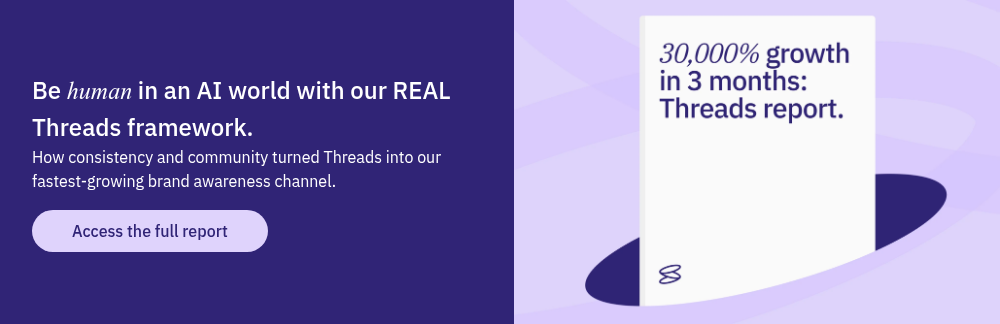
Our process: Schedule daily Threads and balance the feature mentions and common points. Use the rest of the time to hop on reactive content, trends and proactive community management. Read our success case study on how we grew Threads views by 30000% in the first three months and grab our REAL framework.
2. YouTube = Commercial intent & high-converting search
YouTube is not just a video platform; it is a high-intent commercial search engine. In Sendible’s 2026 website traffic data, YouTube delivered a massive 15.93% Session-to-Contact conversion rate with an average session length of 46 seconds (over 3x higher than standard social feeds).
Our process: Because YouTube viewers are actively looking to solve a problem, I focus heavily on optimising our video titles, description copy, and pinned links for high-intent search queries.
3. LinkedIn = Professional mentions and employee advocacy
LinkedIn dominates high-authority B2B search queries. When prospects search for comparison terms (e.g., "Sendible vs Hootsuite"), indexed LinkedIn posts, tag mentions, and employee advocacy posts capture top Google rankings while training LLMs on our business context.
Our process: Instead of posting generic corporate updates, we focus on thoughtful, high-value posts and leverage employee advocacy so our team's collective reach feeds both B2B trust and LLM context.
 Source: @Nico Watson
4. Facebook and Instagram = Historical optimisation and keyword discovery
With Facebook and Instagram driving substantial organic traffic volume, placing relevant keywords in your bio, captions, and tags ensures Google understands your exact feature set.
Our process: When resources are constrained, you don't always need net-new posts every day. We systematically go back and audit older, high-performing Instagram and Facebook posts. Updating bios, post captions and alt text with high-value keywords so Google indexes those historical assets for relevant search terms is another tactic we use.

5. TikTok = Cultural buzz and micro-demos
TikTok gives you quick product demonstrations, behind-the-scenes agency realities, and micro-trends that capture the next generation of social media managers.
Our process: With limited resources, we're balancing our trending content and feature-focused content. We're not trying to create videos from scratch. Instead, we're repurposing our long-form YouTube videos to feed the algorithm targeted information.
How to scale social search without per-seat taxes
Knowing that social media dictates both Google rankings and AI recommendations leaves marketing agencies with a big operational challenge: How do you manage multi-channel social output for dozens of client brands without destroying your margins?
Most legacy social media management platforms penalise agencies and multi-brands for growing. They charge steep "per-seat taxes"—adding $99 to $399 per month for every team member or client reviewer you add to the tool.
|
Feature / Metric |
Hootsuite |
Sprout Social |
Agorapulse |
Sendible |
|---|---|---|---|---|
|
Price per user/seat |
$99 – $399+/mo per user |
$199 – $399+/mo per user |
€79 – €149+/mo per user |
✅ UNLIMITED USERS (Included on ALL plans) |
|
Plan choice and flexibility |
❌ 4 rigid plans (Forced tier upgrades) |
❌ 4 rigid plans (Forced tier upgrades) |
❌ 4 rigid plans (Forced tier upgrades) |
✅ 5 flexible plans (Add extra workspaces à la carte) |
|
True White Label platform |
❌ PDF reports only |
❌ PDF reports only |
❌ PDF reports only |
✅ Custom URL domain and portal (Full platform rebrand) |
When software costs jump every time you hire an account manager or add a client stakeholder, businesses get forced into bad habits: sharing logins, skipping client approvals, or dropping social offerings altogether.
To build a profitable social search offering, agencies need a platform built around agency unit economics:
- Unlimited users on ALL plans: Add your entire team, account managers, and client reviewers without paying per-seat tax penalties.
- Dedicated Client Workspaces: Keep client social profiles, content libraries, approval workflows, and analytics completely segregated in individual dashboards—no messy, single-calendar confusion.
- True White Label solutions: Give clients a sleek experience with custom URL domain logins, custom branding, and personalised portals (not just a lazy PDF logo overlay).
- Frictionless client access: Connect client profiles via integrations so you never have to ask a client for plain-text passwords again.

How to optimise your social content for Google Search and AI engines
To turn your social media presence into an active search and AI indexing asset, execute this four-step optimisation framework:
Step 1: Claim and verify Google Search Console Platform Properties
Add your brand’s YouTube channel, Instagram account, TikTok profile, and X page as verified properties inside Google Search Console. Monitor your monthly search impressions, top queries, and click-through rates to identify which social posts are ranking on Google Web Search.

Step 2: Optimise social copy and alt text for search intent
Treat every social caption like on-page copy. Include natural primary keywords, explicit brand name mentions, and descriptive alt text on all uploaded images and carousels so search crawlers and LLM bots can read your content easily.
Step 3: Run regular indexing checks on Threads and LinkedIn
Regularly monitor how search engines cache your text posts from platforms not available for tracking (at this time). Run site-specific searches on Google to verify indexing status:
* `site:threads.com "your brand name"`
* `site:linkedin.com/in/ "your name" "your brand"`
Step 4: Centralise multi-channel scheduling in dedicated client workspaces
Streamline your publishing and reporting workflows so your team can maintain consistent posting schedules across Threads, LinkedIn, YouTube, Instagram, and TikTok without manual overhead or per-seat fees.
Bottom line
Pulling back from social media to save cash in 2026 is a false economy. It starves AI answer engines of your brand context, shrinks your Google SERP presence, and cuts off high-converting referral traffic.
By managing social media as your primary search layer, you ensure your business stays visible wherever prospects are searching—whether in a Google search box or an AI chat prompt.
Ready to scale your agency's social media management without per-seat taxes? Start your free Sendible trial today and empower your team with unlimited users, dedicated client workspaces, and true white-label client portals.
FAQs about social search and AI indexing
How does social media affect my brand's appearance in ChatGPT and Perplexity?
LLMs and AI answer engines continuously scrape real-time web content, social media posts, public forums, and brand mentions. When users ask AI tools for software or service recommendations, the model evaluates your ambient buzz, user sentiment, and caption keywords across active profiles like LinkedIn, Threads, YouTube, and X to formulate its response.
Can Google Search Console track all social media platforms?
Google Search Console natively supports verified Platform Properties for YouTube, Instagram, TikTok, and X. While platforms like Threads and LinkedIn are aggressively indexed on Google Web Search, Google has not yet introduced dedicated GSC Platform Property tabs for them. You can track their indexability manually using footprint searches like `site:threads.com "your brand"`.
Is Threads or LinkedIn better for driving website traffic?
LinkedIn is superior for targeting high-authority B2B search terms, commercial keywords, and professional entity trust. However, Threads offers significantly faster Google indexing velocity for conversational content and drives massive top-of-funnel brand awareness and referral engagement.
Why shouldn't agencies cut social media services during budget tightening?
Cutting social media starves AI answer engines of your brand context, reduces your overall Google SERP footprint, and eliminates high-converting referral traffic. Because social media now acts as one of the primary indexing layers for search, pausing social updates makes your brand invisible to modern buyers.
Try Sendible free with 14-day free trial.
Leverage Sendible’s extensive integrations to create, schedule, publish, and engage with your posts seamlessly.

Text copied!