The Complete Guide to Digital Marketing for Local Businesses: A Strategic Roadmap for Social Media Managers


Managing digital marketing for local businesses is different from national brand strategies. Whether you're an agency handling multiple restaurants, dental practices, or managing regional real estate franchises, you're juggling endless location-specific content, reviews, local search rankings, and community engagement.
Small business owners have a lot more riding on the success of their social media campaigns. It’s crucial that you understand how to implement digital marketing across multiple platforms so that potential customers find you easily.
The stakes are high. National brands focus on broad awareness. Local businesses need something else: converting online discovery into foot traffic, emails, phone calls, and appointments at specific physical locations.
If you’re selling products, whether it’s cakes or boutique dresses, then you need social views and likes to convert into sales. It’s that simple. Every post, review response, and search result must serve this purpose.
This Sendible guide provides an actionable roadmap for mastering digital marketing for local businesses. You'll learn how to build a solid local SEO foundation, leverage social media to connect with nearby communities, manage online reputation at scale, and implement industry-specific tactics that drive real results.
Because managing this complexity across multiple locations can quickly become overwhelming, we'll show you how tools like Sendible transform chaos into streamlined efficiency.
Local digital marketing uses social and search-based channels to attract customers within a specific geographic area to a physical business location or service area. Unlike broad national campaigns, local digital marketing uses geo-targeted strategies to reach people actively searching for nearby solutions.
The customer journey now begins with a smartphone search. Someone typing "emergency plumber near me" at 10 pm or "best brunch spot" on Saturday morning has high commercial intent.
Potential customers expect immediate, relevant results from businesses they can visit within a short walk or drive, and they want to see reviews they can trust.
The data tells a compelling story:
For local businesses, visibility in these crucial moments isn't optional, it's essential. Local marketing has become the great equaliser. A single-location coffee shop can outrank a national chain in local search results with the right strategy.
Local digital marketing success begins with visibility in Google search results. When someone searches for your client's services with local intent, you need to appear in the Local Pack (the map section at the top), organic results, and across Google's ecosystem. This requires a systematic local SEO strategy, and now you’ve got to factor in making sure you appear in AI-generated results.
Google Business Profile (GBP) optimisation forms the cornerstone of local search visibility. Your GBP listing, especially when your business shows on the Google Map, is often the first impression potential customers have of any local business.
This is even more important for people who are either new to an area, or are only there for a short while (a day, week, etc.) because they need to find particular types of businesses for specific reasons. For example, someone is staying in a new city on business for a few days. Local listings will show them where to go and eat on a night.
Essential GBP setup checklist:
Why photos matter:
Leverage GBP Posts to maintain freshness. These mini-updates appear directly in your listing and signal activity to Google, which is always useful. Share upcoming events, new products, special offers, or community content. Posts older than seven days disappear, so maintain a consistent schedule.
Activate and monitor the Q&A section. Customers can ask questions directly on your listing. If you don't answer them, anyone else can. Add frequently asked questions with detailed answers to control the narrative.
Local keyword research differs from national SEO. This is so valuable because you're targeting geographic intent alongside commercial intent.
Two types of local searches:
|
Search Type |
Examples |
Characteristics |
|
Explicit |
"estate agent in Dallas, TC" "Chicago plumber" "dentist near Birmingham, AB" |
Direct location terms Further along the decision process |
|
Implicit |
"best hotel near me" "open now" "24-hour pharmacy" |
Rely on device location (location being switched on) High mobile intent |
Long-tail keyword strategy:
These longer, more specific phrases have lower search volume but dramatically higher conversion rates. If you combine long-tail with local keywords that’s even more effective, both for traditional SEO and AI-powered results.
Where to find keywords:
For multi-location businesses, create location-specific landing pages. Each location needs its own page with unique, locally relevant content. Include neighbourhood landmarks, local testimonials, and area-specific service information.
Local listings — mentions of your business name, address, and phone number on other websites — validate your business's existence and legitimacy. They also serve to inform AI engines (e.g., AI Overviews, AI Mode, and AI apps) about your business, and this should help you get mentioned in those AI answers.
Plus, directory listings support SEO through backlinks, and that’s also the way that AIs generate answers. So, if you’re a dental practice and you want to appear in the coveted “Dentists near me” result, you need to secure as many places as possible across local listings.
Priority directories by industry:
|
Industry |
Essential Directories |
|
Restaurants |
Yelp, OpenTable, TripAdvisor, Google, Bing |
|
Healthcare |
Zocdoc, Healthgrades, Vitals, Google, Bing |
|
Real Estate |
Zillow, Rightmove, Zoopla, Google, Bing |
|
General |
Yelp, Yell, Facebook, Apple Maps, Bing |
Directory and platform listing best practices:
Social media marketing for local businesses serves a different purpose than for national brands. You're not trying to win over millions of followers. A local approach means that you're cultivating an engaged community of people who live, work, or spend time near your location.
Platform selection guide:
|
Platform |
Best For |
Why It Matters |
|
|
Nearly all businesses |
Local groups, events, robust geo-targeting |
|
|
Visual businesses |
Restaurants, boutiques, hotels, real estate |
|
|
B2B services |
Accounting firms, consultants, legal services |
|
TikTok |
Younger audiences |
Hospitality, retail, entertainment |
The key isn't being everywhere. It's being consistent on platforms where your customers discover local businesses. And that kind of consistency is way easier to achieve when you're using one unified social media dashboard.
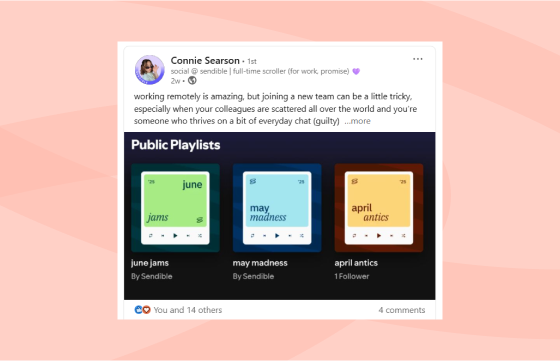
Generic corporate-style content simply won’t and shouldn’t work for local businesses. Your social media must breathe with local personality and community connection.
Content pillars for local success:
Real-world example:
Look at Sage Restaurant group, with 42 locations around the US.
Every restaurant is independent of one another and each has a passionate sales and marketing team behind them that are tasked with driving excellent customer engagement through every marketing channel that reaches the customer, including social media, and increasing customer traffic into their restaurant.
Results:
This approach works because it provides genuine value while showing why these restaurants are fun places for people in those areas.
Organic reach continues declining across all platforms. Paid social advertising fills this gap. For local businesses, geo-targeting makes it incredibly cost-effective.
Facebook and Instagram Ad targeting options:
Different advertising campaigns that drive local results:
|
Campaign Type |
Best For |
Example |
|
Store visit |
Drive foot traffic |
Retail shops, restaurants |
|
Event response |
Promote local events |
Grand openings, workshops |
|
Reach |
New location awareness |
Recent openings |
|
Offer claims |
Limited-time deals |
Flash sales, first-visit discounts |
Advanced targeting example:
A boutique fitness studio targets:
Track offline conversions:
The true value is far more than just clicks. It's whether those clicks translate to customers walking through your door.
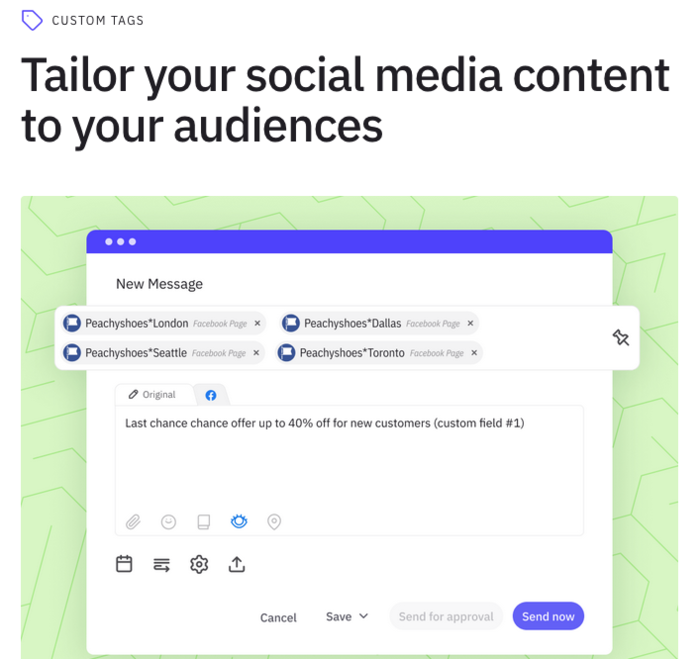
Managing social media for one local business is time-intensive. Managing it for ten, twenty, or fifty locations becomes impossible without the right infrastructure.
The reality for multi-location businesses or agencies that support them:
For example, say you handle social media for a dental practice with 8 locations. As an absolute minimum, every location needs:
That's 24 separate accounts requiring unique, locally-relevant content multiple times every day and week. Add monitoring comments, responding to messages, tracking reviews, and monthly reports, and it’s no wonder you're drowning in chaos.
Why manual posting doesn't scale:
|
Challenge |
Sendible Solution |
|
Multiple locations |
Bulk schedule posts across all locations with location-specific customisations |
|
Quality control |
Establish approval workflows without bottlenecks |
|
Scattered conversations |
Monitor all messages and comments from one unified inbox |
|
Client reporting |
Generate comprehensive reports comparing location performance |
|
Team collaboration |
Assign conversations, tag responses, ensure nothing gets missed |
Time savings example:
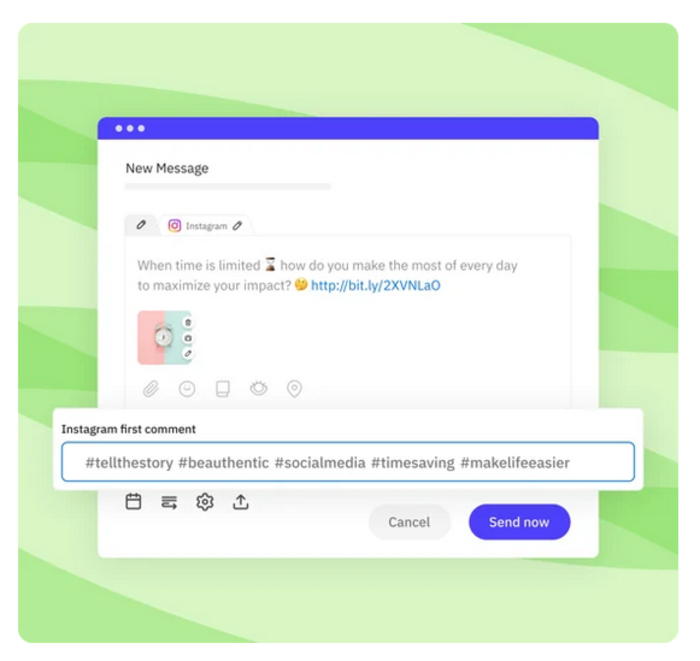
Create one content template for a teeth whitening promotion. Deploy it across 8 location profiles. Each version automatically customises with location-specific images, addresses, and contact information. What takes hours manually happens in minutes.
The competitive advantage isn't just efficiency, it's consistency. Brand standards remain uniform, no location gets neglected, and strategic initiatives get implemented across your entire portfolio simultaneously.
Online reviews management represents the most powerful trust signal in local digital marketing. Modern consumers trust online reviews as much as personal recommendations.
Why reviews matter:
Ranking factors Google considers:
A business with 200 four-star reviews and active responses typically outranks a competitor with 50 five-star reviews that go unanswered.
Most satisfied customers never think to leave a review unless prompted at the optimal moment. You need systematic approaches.
Review generation strategies:
|
Method |
When to use |
Why it works |
|
QR codes |
At checkout, on receipts, at exits |
Instant access while emotions are warm |
|
Email follow-ups |
24 hours after service |
Automated, personalised, and convenient |
|
In-person asks |
During moments when customers are happy with your product/service |
Highest conversion rates |
|
Text or WhatsApp reminders |
Post-appointment |
High open rates, direct |
Timing best practices:
Staff training scripts:
"I'm so glad you loved your meal! Would you mind sharing your experience in a quick Google review? It really helps our small business."
Critical rules:
Review response separates amateur businesses from sophisticated operations. Every review — positive, negative, or neutral — deserves acknowledgment. In many ways, the negative ones demand even more acknowledgment, because otherwise it reflects very badly on your business.
Positive review response template:
"Thanks so much, [Name]! We're thrilled you enjoyed [specific detail they mentioned]. We'll make sure [staff member] knows you appreciated [specific action]. Can't wait to welcome you back soon!"
Why respond to positive reviews:
Negative review response strategy:
|
Step |
Action |
Example |
|
1. Acknowledge |
Show empathy |
"We're genuinely sorry your visit didn't meet expectations, Here’s what we are going to do to put this right: [specific action]. Best, James, Manager/Owner." |
|
2. Apologise |
Even if you disagree |
"This isn't the experience we want any guest to have." |
|
3. Move offline |
Provide direct contact |
"Please contact me at [phone/email] so we can address this properly." |
|
4. Respond quickly |
Within 24 hours |
Shows you monitor and care |
What your response demonstrates:
Additional response guidelines:
Different local business types require tailored best social media tools for small business and industry-specific tactics. Here's how to optimise local business advertising tips for three high-value sectors.
Real estate is intensely local, visual, and trust-dependent. Making it perfect for a comprehensive local digital marketing campaign.
Visual marketing essentials:
Open house promotion strategy:
An example of how to showcase a luxury property visually
Establish neighbourhood authority:
Create comprehensive neighbourhood guides covering:
Content that demonstrates expertise:
Lead nurturing for long sales cycles:
Real estate purchases aren't impulse decisions. Buyers research for months before acting.
Nurture sequence:
Strategic partnerships:
These partnerships provide value while generating qualified referrals.
Hotels compete in a crowded, price-sensitive market where visual appeal and local connection drive bookings.
Instagram as your primary platform:
Hospitality is the most visually-driven industry in local marketing.
What to photograph:
An example of a hotel using images to boost engagement online:
User-generated content tactics:
Flash sales for slow periods:
Hotel inventory needs to move like tins of tuna off the shelves. Empty rooms generate zero revenue.
Strategy:
Review management across booking platforms:
|
Platform |
Audience |
Priority |
|
|
Local searchers |
High |
|
TripAdvisor |
Travel planners |
High |
|
Booking.com |
Budget travellers |
High |
|
Expedia |
Package seekers |
Medium |
|
Hotels.com |
Loyalty members |
Medium |
Centralise review monitoring to catch and respond to every review regardless of platform. Review response rate directly impacts visibility on booking platforms.
Highlight unique local partnerships:
Modern travellers seek authentic local experiences.
Partnership opportunities:
Promote these partnerships as differentiators that chain hotels can't match.
Become a local insider guide:
Healthcare marketing faces unique challenges: high competition, trust requirements, regulations, and the need to demonstrate both expertise and care. Here's how to market a dental practice locally effectively.
Social proof drives patient acquisition:
Healthcare decisions are deeply personal and trust-dependent.
Testimonial strategy:
An example of a dentist using images to boost engagement online:
Before-and-after content:
Visual results speak louder than words for cosmetic procedures.
Services to showcase:
Best practices:
Educational content builds trust:
Patients have endless dental health questions.
Content topics:
Content formats:
Benefits:
Paid advertising for high-value procedures:
|
Procedure |
Target Audience |
Ad Strategy |
|
Dental implants |
Adults 45-65 |
Before/after visuals, financing options |
|
Veneers |
Adults 35-55 |
Smile transformations, confidence messaging |
|
Invisalign |
Adults 25-45 |
Discreet treatment, lifestyle benefits |
|
Teeth whitening |
Adults 25-55 |
Quick results, special offers |
Targeting approach:
Patient retention tactics:
Community involvement:
This community involvement builds brand awareness while demonstrating genuine care for local health beyond profit.
Multi-location practice considerations:
Each location needs distinct marketing acknowledging its specific community.
Location-specific tactics:
Digital marketing for local businesses demands a sophisticated, multi-channel approach. From building an unshakeable local SEO foundation through Google Business Profile optimisation and citation building, to cultivating engaged communities through social media marketing for local business, to managing online reviews that make or break reputation—every piece requires dedicated attention.
The scaling challenge:
Complexity multiplies when managing multiple locations, clients, or industries simultaneously.
Common pain points:
This overwhelming operational challenge requires more than good strategy. It requires the right infrastructure.
Why centralised management is essential:
The best digital marketing tools for small businesses and the agencies that serve them aren't luxuries—they're necessities. When every minute spent manually managing accounts is time not spent on strategy, creativity, or client relationships, efficiency becomes your competitive advantage.
What Sendible delivers:
|
Feature |
Benefit |
|
Deploy customised content across all locations simultaneously |
|
|
Monitor all social conversations from one place |
|
|
Social content management tools & Approval workflows |
Maintain quality without bottlenecks |
|
Manage reviews and posts alongside social platforms |
|
|
See what’s working and what isn’t and demonstrate value across all locations |
|
|
Assign tasks, track progress, ensure nothing's missed |
The competitive advantage:
Agencies and managers who thrive don't necessarily have the biggest budgets or largest teams. They combine strategic expertise with operational excellence, leveraging the right tools to scale quality execution across their entire client portfolio.
Ready to transform your local digital marketing?
Explore Sendible's features designed specifically for local businesses, multi-client, and multi-location social media management. Or subscribe to our email newsletter for more expert guides, industry insights, and actionable tactics that help you deliver better results for your local business clients.
Local digital marketing isn't getting simpler. Customer expectations are higher than before, platform algorithms make it harder to engage with your customers, and you’ve got competitors to consider. The question isn't whether you need better social media tools; it's how quickly you can implement them to stay ahead.
Local digital marketing focuses on reaching customers within a specific geographic area. Your area. Unlike national campaigns, these campaigns need to emphasise hyper-local tactics, like the following:
Review management to drive foot traffic, calls, and appointments.
Google Business Profile (GBP) is one of the most influential ranking and conversion tools for local businesses. It affects visibility in Google Search and Maps, controls how your business appears to nearby searchers, and directly impacts calls, clicks, and direction requests.
It also influences how your business appears in AI-generated answers, including AI Overviews (AIOs), AI Mode, and AI apps like ChatGPT and Claude.
The best platforms depend on the type of business. Facebook and Instagram are essential for most local and national brands. TikTok benefits hospitality and entertainment, while LinkedIn is ideal for B2B services. The goal is not to be everywhere; it's to be consistent where your local audience and potential customers are active.
The most effective methods include QR codes, email follow-ups, SMS or WhatsApp requests, and in-person requests at the moment when customers are happy with the products or services you are selling. Timing and convenience significantly increase the chances of customers leaving positive reviews.
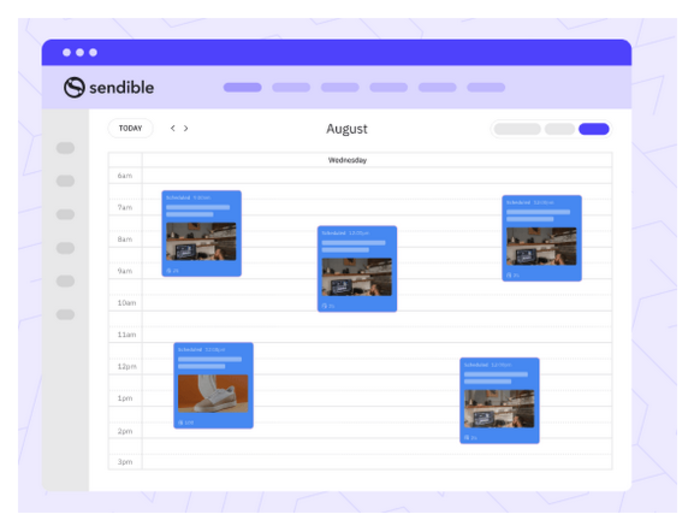
Tools like Sendible streamline multi-location management by centralising scheduling, review monitoring, approvals, collaboration, and reporting. This reduces manual work, maintains brand consistency, and helps agencies scale efficiently.
Leverage Sendible’s extensive integrations to create, schedule, publish, and engage with your posts seamlessly.