

Auto industry marketing is going through a transitional period. This is because the car-buying journey has never been more fragmented (and going through an economically and tariff-imposed period of low-growth).
A potential buyer might watch a TikTok on Monday, ask Claude "best hybrid SUV for long motorway commutes" on Wednesday, visit your website via a retargeted Instagram ad on Friday, and walk into the showroom the following weekend
If your marketing isn’t driving traffic, interest, and conversions during those touchpoints, then you’re losing out to competitors. Car dealers need to do this on a local, state, and nationwide level.
Auto industry marketing in 2026 is about doing the right things in the right sequence, with the right data behind them. In this guide are 10 strategies car dealerships, franchises, and multi-location brands can implement straight away, either in-house or with the support of a marketing agency.
Key Takeaways
- The car-buying journey is fragmented across multiple digital and physical touchpoints — your marketing needs to make an impact across all of them to attract your ideal customers.
- First-party CRM data is now your most valuable and trustworthy targeting asset.
- AI answer engines (AEO/GEO) are replacing traditional search results — structure your content to feed them or risk invisibility.
- Community-building, informative, and engaging content on social media outperforms inventory posting to generate a higher ROI and build more brand equity.
- Short-form, authentic video content consistently outperforms polished production videos to sell cars and build trust.
- Omnichannel consistency — across social, email, paid, and in-dealership — is essential to delivering on your brand promise.
- EV marketing requires an educational, and an honest approach to build genuine trust with cautious buyers.
- Social proof, especially video testimonials captured at handover, is one of the highest-converting content formats available.
What are the biggest shifts in auto industry marketing for 2026?
Three structural changes are reshaping how automotive brands and dealerships need to think about their marketing, and all three are happening simultaneously.
- The "Relational" era: The traditional transactional model — advertise, convert, repeat — is being replaced by lifecycle marketing. Sales start the beginning of a customer relationship rather than its conclusion.
Service reminders, ownership content, loyalty programmes, and community-building are now part of the marketing function, not just the CRM team's responsibility.
- The Death of 3rd-party cookies: With major browsers having outdated or restricted cookie-based tracking (and more people than ever opting out), the granular audience data that powered automotive display advertising for a decade no longer works.
First-party data — opt-in information from customers and potential customers — is now the only targeting currency that can be owned, trusted, and used over time. First-party data (in CRMs) is becoming increasingly important.
Making data-driven marketing essential for creating personalised advertising campaigns, improving targeting, and optimising customer journeys while adhering to privacy regulations.
- The rise of AEO and GEO (Answer Engine Optimisation and Generative Engine Optimisation): When a potential buyer asks Gemini, ChatGPT, Claude, or Perplexity which dealership in their area has the best service department, they are not getting a list of blue links to click through.
Potential customers are now getting a synthesised answer. If your dealership's digital footprint is not structured to feed those AI engines, AI Overviews (AIOs), and Google’s AI Mode with clear, accurate, and authoritative information, your dealership won’t exist within AI answers.
Even if you’ve invested extensively in SEO. In 2026, you need to work with a marketing agency that can support AEO/GEO, and this includes social media marketing.
Now, let’s dive into 10 ideas for auto marketing that independent dealers, franchises, and multi-location brands can implement straight away
Car dealership social media content calendar
10 Auto industry marketing strategies for social media success
1. Master "social-first" community building
Car dealers and franchises that will gain the most organic traction on social media in 2026 are not posting inventory. They are building communities around the culture of car ownership — and there is a significant difference.
Inventory posts ("2026 Ford Explorer, available now, click to enquire") are useful, but not very engaging. This type of content is going to do a lot better:
- Community content — a thread about the best roads within two hours of your city
- Or about where all of the EV chargers are in the local are
- A poll about which colour option your followers would spec
- A weekly "build update" from a customer restoring a classic.
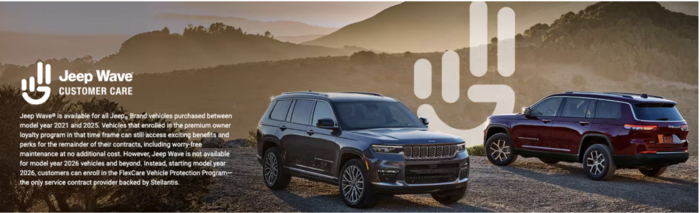
Successful examples include Jeep's "Jeep Wave" program, which fosters loyalty and engagement among owners through exclusive events and online groups. Another example are Tesla's active owner forums and referral programs that encourage authentic customer relationships.
Platforms like Discord and Facebook Groups are particularly effective because they create a persistent, searchable space where enthusiasts gather. A Ford dealership running a Ranger Owners Group, or an EV-focused dealer hosting a charging tips community, is building an asset that compounds over time rather than evaporating after a campaign ends.
2. Implement hyper-local AEO (Answer Engine Optimisation)
When someone types "best hybrid SUV for Edinburgh winters" or "most reliable used cars under $15,000 near me" into an AI search tool, the answer they receive is assembled from sources that AI engines have determined to be authoritative, specific, and well-structured.
Automotive brands that invest in hyper-local AEO are positioning themselves to be those sources. Do that now, while there’s still a viable window to secure the top positions. That window will soon close.
In practice, this means creating content that directly answers the specific questions your local buyers are asking, not just optimising for generic keywords. A dedicated page that addresses "which EVs have the best range in cold weather" with accurate, cited data is far more likely to be cited in AI answers than a generic model description page.
Marketers should also create content that demystifies EVs, explaining charging infrastructure and the tech roadmap. Structured data markup (schema), consistent management of your Google Business Profile, and a regularly updated FAQ section are the technical foundations of this approach.
3. Use AI-driven creative automation for multi-channel scaling
A modern automotive social media strategy requires presence across at least five channels — Instagram, TikTok, YouTube, Facebook, and LinkedIn. Every one of those has its own format requirements, audience expectations, and optimal posting cadence.
For a small marketing team managing one brand, this is demanding. For an agency or dealer group managing multiple brands, it’s unworkable without automation.
AI-driven creative automation handles the mechanical work of content adaptation and scheduling, freeing teams to focus on strategy and original creative. Tools like Sendible's scheduling and content features allow teams to plan, schedule, and approve campaigns in advance. AI tools can also analyse customer data to predict trade-in readiness and maintenance needs.
The goal is to automate the distribution and operational workloads so that your team's creative energy goes into work that actually requires critical and creative thinking.

4. Prioritise short-form "Truth" videos
The polished 60-second TV commercial format has migrated to digital, and these don’t always perform well on smaller screens.
Audiences — particularly on TikTok, Instagram Reels, and YouTube Shorts — have developed a fast and accurate instinct for content that feels like an advertisement. Most people scroll past ad-style videos reflexively.
What is working in automotive social media for 2026 is raw, specific, product-truth content:
- A genuine walkthrough of a boot space with a family's actual weekly shop loaded in
- A "wait for it" acceleration clip filmed on a quiet road
- An honest answer to "what do I actually wish I knew before buying this car."
The format shift also has a practical advantage: a sales executive filming a 2-minute honest review on an iPhone or Google phone is faster, cheaper, and often more effective than a produced asset that takes two weeks and a significant budget to deliver.
Car dealership social media AI assistant
5. Leverage first-party data for social retargeting
Your CRM contains some of the most valuable targeting information available to your dealership:
- Service history
- Purchase dates
- Car model preferences
- Enquiry records
Most of this valuable data is sitting unused in the context of social advertising. Syncing CRM data with Meta's Custom Audiences allows you to build remarketing segments that are far more precise than anything available through interest-based targeting alone.
For example:
- Customers who bought three years ago and are statistically likely to be approaching their next purchase cycle.
- Service customers who have never bought a new car (yet)
- People who enquired about a model you no longer stock and might be interested in its replacement.
Each of these is a distinct audience that warrants a distinct message — and the data to build them already exists in your system. The majority of leads choose the first dealership to respond to an inbound question, so immediate responsiveness in lead management can make a significant difference.
Tracking engagement and sentiment across social channels alongside CRM data gives you a more complete picture of where individual customers are in their decision journey.
6. Partner with "niche" micro-influencers
The era of celebrity automotive endorsement is losing credibility fast. Audiences are increasingly sophisticated about the difference between a paid placement and a genuine recommendation, and they are being turned off by celebs and “big name” influencers.
Micro-influencers with followers in the 5K to 50K in specific automotive niches — overlanding, track days, EV advocacy, van conversions, classic car restoration — deliver something a celebrity cannot.
A micro-influencer speaks with genuine authority with an engaged audience that actually trusts their opinion on vehicles. A feature from a well-regarded local car reviewer or an overlanding enthusiast with 15,000 followers will often generate more qualified leads than a campaign involving a figure with ten times the reach and none of the genuine authority.
Local micro-influencers carry an additional advantage for dealerships: their audience is geographically concentrated in your actual catchment area. This means that their reach translates directly into potential footfall rather than dispersed national impressions. Selling 1 or 2 cars could easily pay for a year’s worth of micro-influencer content to promote a local dealership.
7. Adopt an omnichannel "single source of truth"
One of the most common failures in automotive marketing is the gap between what the marketing team communicates and what the service department, sales team, or finance desk says to the same customer.
A buyer who sees a social ad promising a seamless EV purchase experience and then encounters a broken sales process is a missed opportunity. Chances are, they will tell people in-person and share a bad experience online. Marketing messages need to match real and digital channels and experiences.
Omnichannel alignment means ensuring that the messaging, offers, and information communicated across social, email, paid, and in-dealership channels are consistent and connected. All of that is easier when you’ve got a shared brand hub and content library.
This also means that social media teams need to coordinate with operations, finance, and sales teams. Social media team members, including agencies or freelancers, also need to work directly with branches/dealerships to ensure content is synchronised with what’s actually happening on-the-ground (like new deliveries, sales, etc).
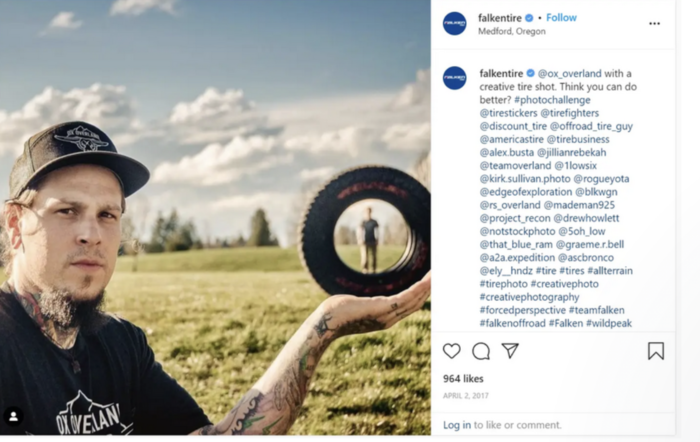
8. Optimise for visual and voice search in cars
The software-defined vehicle (SDV) is changing where automotive marketing needs to appear.
Modern cars — particularly EVs and premium models — are increasingly integrating Google-powered infotainment systems, voice assistants, and location-aware search directly into the driving experience.
When a driver asks their car to find a nearby dealership or the best-rated service centre, your digital presence needs to appear. Same as in AI-generated results and answers.
Optimising for in-car search involves the same foundations as local AEO:
- Consistent NAP (name, address, phone) data
- A well-maintained Google Business Profiles
- Structured schema markup.
But you need to layer in voice, so it means working with an SEO/marketing agency that knows how to achieve this.
Voice search queries are phrased differently from typed searches, and content that mirrors natural spoken language performs better in this context. The shift toward digital-first car-buying experiences has also grown with the availability of AR and VR, allowing customers to explore vehicles and features remotely.
9. Showcase "sustainability as a service"
Environmental claims in automotive marketing aren’t always believed. Dealers need to make sure they’re getting accurate information from manufacturers. Years of automotive-sector greenwashing have made consumers appropriately sceptical of sustainability messaging that cannot be verified.
Car brands that are making an impact are those treating sustainability as operational content rather than campaign messaging. Examples of this could include:
- Real-time charging data
- Honest comparisons of the total cost of EV ownership
- Content that addresses range anxiety with specific route data, rather than dismissing it
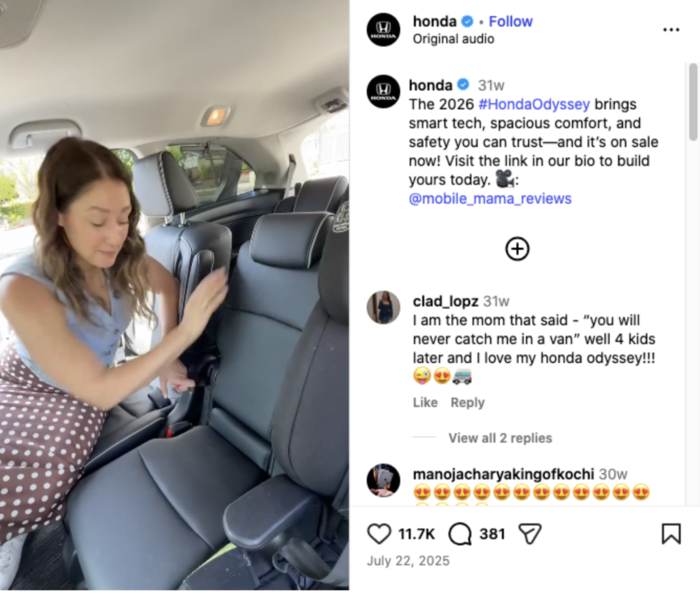
Material like this builds trust with buyers who are genuinely considering switching to a hybrid or EV car. Interactive calculators for charging costs and local charging network maps are examples of educational content that help consumers understand the practicalities of EV ownership.
EV ownership lifestyle content — charging on a long road trip, the reality of home charging installation, what happens at a motorway rapid charger — is highly searchable and shareable. Millions of people are curious about it, and not enough credible sources are providing genuinely useful, honest answers.
 Source: @mobile_mama_reviews
10. Use "social proof" as a conversion engine
Customer reviews and testimonials have always been important in the buying journey. Now, brands need to turn user-generated content (UGC) and testimonials into something more engaging for social platforms.
Short video testimonials — a 45-second clip of a customer on delivery day, filmed on a phone by the sales executive — carry more emotional weight. It’s because they’re authentic and relatable, so they perform far better as social content than written reviews alone. At the same time, you need written reviews for SEO, GEO/AEO, and Google Business Profile (GBP) purposes.
Capturing these kinds of social moments isn’t random. You need to have an organised system to achieve this. For example:
- Start with a simple request at the point of handover
- A template message sent 48 hours after delivery asking for a video reaction
- A WhatsApp number where happy customers can send clips when they’ve filmed them.
This user-generated content (UGC), reposted with permission across social channels, provides authentic social proof that no polished, scripted, and edited videos can replicate.
Delivery-day content, in particular, has become a reliable high-engagement format — there is genuine emotion when someone takes delivery of a new car, and that performs well on social media. Especially Facebook, Instagram, and TikTok.
How can social media teams manage multiple auto brands effectively?
The operational challenge underlying all ten of these strategies is the same: social media teams in the automotive sector are overworked, trying to juggle multiple locations, platforms, and compliance pressures.
The answer is not more staff — it’s a better operational infrastructure.
A unified social media management dashboard that allows teams to manage multiple brand profiles, schedule content in advance, monitor DMs and mentions across channels in real time, and pull performance data into a single report will make everyone more productive.
Sendible is built specifically for this kind of multi-brand, multi-channel management. Teams can:
- Maintain distinct brand voices for every individual account
- Establish simple approval workflows so nothing goes out unchecked
- Use analytics to identify which content formats are actually driving engagement and inbound leads, test drives, and walk-ins/dealership visits.
For automotive groups managing five, ten, or twenty dealerships, the consolidation alone saves countless hours every week. Time that can go back into the creative and strategic work that no dashboard can do for you.
If you are managing social media across multiple automotive brands and feeling the operational strain, Sendible's free trial is a useful starting point.
Try Sendible free with 14-day free trial.
Leverage Sendible’s extensive integrations to create, schedule, publish, and engage with your posts seamlessly.

Text copied!