

The world of insurance is built on trust.
Yet, many insurance agencies rely on transactional social media posts.
These hard-sells (like "Buy Now!" or "Get a Quote!") fail to build the necessary credibility. It is time to shift your focus from chasing expensive, exhausting cold leads to nurturing a profitable client pipeline.
A relationship-first strategy focuses on becoming a trusted advisor, not just a policy seller. It uses social media to strengthen existing connections, leading to higher client lifetime value and more referrals.
Ready to change your social media approach? This guide will cover the three essential content pillars for building trust and the critical tools for multi-agent compliance and consistency.
Why the transactional approach fails insurance on social media
Transactional social media content might seem like the best way to close deals! And this might just work if you've already created a high degree of confidence and faith in the agent.
Transactional content rarely builds this foundation. It's BOF (bottom-of-funnel) content, and you should only sprinkle it here and there, or even better - use it in one-on-one communications.
Social media is inherently a relationship channel. Users are there to connect, engage, and be entertained. When an agency or agent constantly pushes sales pitches, the content feels impersonal and robotic. This can cause hard sells to fall flat with the audience.
Just look at it from your own perspective and ask yourself: Do you log in to TikTok or Instagram to get spammed by pushy, salesy posts? Or do you log in to relax, find relatable content, and learn something new?
But the very nature of social media isn't the only reason why your feed shouldn't be packed with transactional posts.
Cold lead generation is an expensive, low-ROI social media strategy for insurance companies and agents. As you probably already know, loyal policyholders are key to long-term profitability. Instead of focusing solely on cold lead generation, start using social media as a lead-nurturing channel.
What are the three content pillars for high-trust engagement?
Now that you know why your social media strategy should be trust-first oriented, let's talk about how to achieve it.
The relationship-first approach requires establishing all your local offices as reliable, expert advisors. This is achieved by mastering three distinct content pillars.
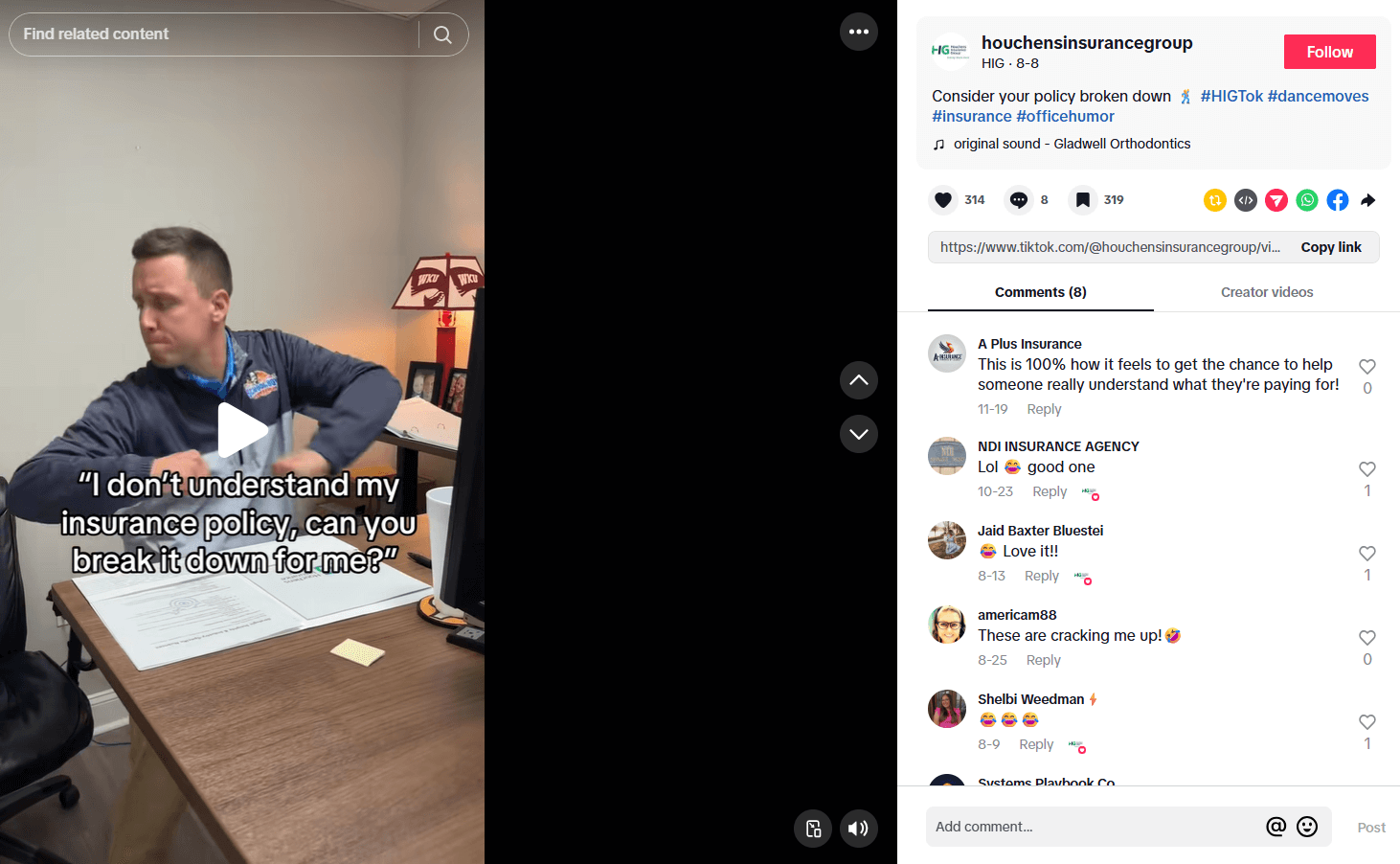
Pillar 1: Accessible education and reactive content
 Source: @houchensinsurancegroup
The goal is to simplify complex policy information without using jargon or corporate speak. You should position the local agent as the expert and guide. Or you can just have them hop on trends and repurpose them to fit your niche.
Creating relatable content on TikTok, Instagram and Threads will not only help with brand awareness, but also allow your target audience to get to know you. The OTHER side of you.
- Reactive content: Follow trends, join conversations, truly connect with your audience. This is what we did, and we increased our views by 30,000% on Threads in three months.
-
Timely and relevant content: Post friendly reminders for policy review dates or seasonal risks (e.g., severe weather preparation).
-
Simplify the complex: Create short videos that explain the difference between a deductible and a premium.
-
"Did you know?" tips: Address common industry misconceptions with quick, shareable posts.
-
Expert advice: Create accessible educational content on financial planning or risk management.
Pillar 2: Humanising stories and community involvement
 Source: State Farm
Insurance is a deeply personal service. People prefer to buy from agents they know and trust. This pillar is essential for showing the human side of your multi-agent brand.
-
Behind-the-Scenes: Share team spotlights or quick "day in the life" content of agents.
-
Local focus: Highlight the local branch's participation in community events or charity drives. This shows your commitment to the area.
-
Personal stories: Allow agents to share their own experiences or how they helped a client navigate a difficult claim. This provides authentic, relatable content.
Pillar 3: Social proof and client appreciation

Source: @generaliitalia
Use real-world success to reinforce credibility. Have your clients tell their stories. They might not relate to you as a brand, but they will relate to a real story. Social proof is the best way to start building the trust in your advice and then services.
-
Client testimonials: Share positive quotes or short video reviews from satisfied clients (always with permission).
-
Success stories: Detail how your agency efficiently resolved a claim or saved a customer money.
-
Engage with users: Actively like, share, and respond to user-generated content that mentions your agents or offices. This shows you care about everyone who reaches out.
The multi-agent problem: Consistency and compliance
Implementing this relationship-first strategy is challenging for multi-agent networks. Every agent needs to maintain their local, authentic voice. However, the brand requires absolute consistency and regulatory compliance from headquarters.
The need for a centralised content workflow
Agents often use separate tools or personal accounts, making central oversight nearly impossible. This decentralisation is a major pain point for marketing teams. A single platform is necessary to manage all agent profiles. This ensures the headquarters maintains central control while empowering agents with local flexibility.
Ensuring compliance with mandatory post approvals
Compliance is non-negotiable for the insurance industry. Posts cannot go live without review, which creates significant compliance risks.
-
Define approvals: Administrators must define the approval workflow for every post.
-
Ensure standards: This process ensures content meets both regulatory and brand standards.
-
Scaling: The approval system must be easy to manage across dozens or hundreds of agents.

How to scale your relationship-first strategy without sacrificing time
For a relationship-first strategy to succeed, it must be efficient. Agents are busy, and marketing teams cannot spend all their time chasing updates.
Centralised content libraries and bulk scheduling
Marketing teams can cut hours of manual posting and reporting every week.
-
Shared content: A Content Library allows HQ to distribute pre-approved, compliant content to all agents. Agents can then access this resource and add their localised, authentic flavour.
-
Bulk efficiency: Bulk scheduling and importing features enable fast, consistent publishing across hundreds of profiles. This solves the problem of agents posting inconsistently.

Unified reporting on agent performance
A relationship-first strategy is a long-term play. Performance tracking cannot be manual or non-existent. Leadership must gain full visibility into what content is driving engagement and ROI. Which is where Sendible's custom and automated reports come into play.
-
Eliminate manual reporting: Reporting cannot be manual or non-existent.
-
Unified dashboards: Reporting dashboards must show both network-wide and individual agent performance metrics.
-
Measure impact: This allows leadership to measure the true impact of the relationship-first content on engagement and lead generation.

Next step: Register for the free webinar
The strategy is clear: focus on relationships, consistency, and compliance. The next step is mastering the tools and workflows.
Join us for a free, in-depth session on how to move from chasing cold leads to nurturing a profitable, high-trust pipeline.

Try Sendible free with 14-day free trial.
Leverage Sendible’s extensive integrations to create, schedule, publish, and engage with your posts seamlessly.

Text copied!